Category Archives: Elections

Live Blogging the President’s Convention Speech

Alright, I’ve been asked to live blog the President’s speech.  Hopefully it will be received better than last night’s blog about Clinton!

As always, join in (that means you, students, who are at loose ends on campus!)

It’s pretty clear that the Obama team thinks that the auto bailout is a winner, particularly in the midwest battleground states.  Almost every speaker has brought this up.

The real irony of Biden praising the President’s decision to go ahead with the Bin Laden raid is that Biden opposed it.

And he’s on!  (By the way, was that George Clooney narrating the Obama film?  Was Clint too busy?)

A shout out to Biden – which is needed, since he didn’t get a prime time speaking slot.

There’s genuine affection for this guy in the convention hall.

Here he’s going to reference the major themes of his campaign: he inherited the economic crisis, one precipitated in part by Romney-like outsourcing….

Here he trumpets his tax cuts for the middle class…

Look for him here to remind voters that this is a difficult path to follow…

Every president – and presidential hopeful – has learned the Reagan/Carter lesson – always, always appear optimistic, and praise the American people…

Here comes the automotive shout-out again…..they really think this is a winning theme against Romney…

He references outsourcing jobs, but he is not going to mention Romney directly by name more than once…

What he doesn’t say is that the reduction in oil imports is almost entirely due to a sluggish economy…..

When it comes to coastal drilling, he’s been burned once – won’t happen again….

The twitterverse is getting antsy – speech is (so far!) lacking the inspirational atmospherics of previous presidents.  I  say wait …. .

Conservative twits are pointing out that increase in oil production is on private lands – not federal.

We ended the war in Iraq?  The fact checkers will have a field day with this – Bush negotiated the withdrawal.

Who, in 2008, would have predicted that Obama would be touting his foreign policy credentials, and dissing his opponent’s?

(By the way, who is his “opponent”?)

For what it is worth, Romney has endorsed an Afghanistan troop draw down.  It’s a sign of the times that the Democrat is running on his foreign policy credentials, while the Republican wants to focus on the economy.

From here on out look for him to emphasize optimism, and to give a shout out to the people….

He ends with a soaring shout out to the people.  but will it sell in a period  of 8.3% unemployment?

Lots of tweeters tweeting that this is a “safe” speech.  It’s not – notice that he’s focusing on the future.  This is a speech you would expect from a challenger.  He’s not running on his record so much as running on the promise that things will get better.

The ending is telling – entirely focused on the future, with the hope of better things to come.  It’s clear that he wants to convince voters that he’s begun to turn this around, but that he needs more time.  Will voters buy this?

Democratic tweeters acknowledging this isn’t his best speech, but certainly shows a change in tone.  More presidential.

Some Obama supporters like Ezra Klein are arguing that this was a “safe” speech because it didn’t mention specifics. I disagree – this was a forward looking speech because he knows “his” record isn’t something to highlight.  His goal here is to persuade voters that he needs more time to fix the mess he inherited.

The other interesting part of this speech is how much time he spent on foreign policy  – what a change from 2008, when he ran against the Bush policy on terrorism.  Now Obama is presenting a much more muscular foreign policy profile designed to highlight his commander in chief credentials.  Note that Romney and his surrogates largely ignored foreign policy, in the belief that this election will turn primarily on the economy.

In the end, Obama played to his base more than to the undecideds…. his speech was strong on rhetoric and looking ahead, but not much here on defending the major policy initiatives of his first term – the stimulus bill, or health care.  And that’s understandable – those are very polarizing issues.   This is a reminder that it’s easy for surrogates to give soaring speeches, but much harder for the President to go on the attack without appearing less presidential.  What a difference four years make.

With the conventions over, we look toward the general campaign. I’ll be on tomorrow addressing the convention bumps, (or lack thereof) but the next major events that have the potential to change the campaign narrative are the three October debates.  In the meantime, it will be interesting to see what impact these two conventions have on the polling.  Romney has made incremental gains starting from before the RNC, and is now tied with Obama (or ahead) in most polls. Will that trend survive the DNC?

Stay tuned.


Why Isn’t Romney Running Away With This Election?

Charlie Cook, the venerable elections and polling guru whose Cook Report is a must read for political junkies, posted an interesting article today headlined “It Shouldn’t Be Close.”  In it, Cook argues that based on the economic “fundamentals” alone, Romney should be leading Obama in the polls.  He writes, “Whether one looks at polling measurements of whether voters think the country is headed in the right direction, at consumer confidence, or at key economic measurements such as growth in gross domestic product, deviations in the unemployment rate, or the change in real personal disposable income, it is puzzling, to say the least, why polls show President Obama and Mitt Romney running neck and neck. Incumbents generally don’t get reelected with numbers like we are seeing today.”

If the economic fundamentals are as lousy as Cook suggests, why do the national polls suggest that not only is Obama still in the race, he is probably slightly ahead? Cook believes it is because of the campaign missteps Romney has made, such as allowing Obama to frame the media narrative in terms of Romney’s tax returns and Bain experience, combined with Romney’s lackluster personality.  Cook’s explanation, focusing as it does on issues of campaign tactics and personalities, would likely meet with approval by most pundits.  As longtime readers won’t be surprised to hear, however, I think Cook is wrong to dismiss the economic fundamentals.  In fact, those fundamentals – at least some of them – do not necessarily suggest that this race “should not be close.” As I noted in an earlier post, based on second quarter GDP growth numbers alone, history suggests Obama will win a smidgen more than 50% of the two-party popular vote.  True, this doesn’t indicate a landslide victory for Obama, but neither does it suggest Romney should be winning this race, despite Cook’s assertion to the contrary.  Of course, 2nd quarter GDP growth alone doesn’t explain everything about an election outcome.  But if even you include other factors, such as Obama’s current approval rating and the fact that he’s an incumbent, history still gives Obama a slight advantage in the popular vote, as indicated by forecast models by Alan Abramowitz and John Sides and Lynn Vavreck.

Of course, as Sides reminds us, these forecasts are based on probability models that include a fair share of uncertainty, so while the economic fundamentals suggest Obama should win, it doesn’t mean he will.  (This gives me a chance to plug John and Lynn’s new book on the 2012 election, which I am certainly going to assign in my elections course.)  I want to go a step further than John, however, and suggest that we should not dismiss Cook’s analysis in its entirety.  For, in truth, not all forecast models based on economic fundamentals indicate that Obama should win this election.  For example, Jim Campbell points out that if we expand the timespan of forecasters’ analyses to include average GDP growth from a president’s second year through the second quarter of an election year, Obama’s reelection chances look a bit less promising.

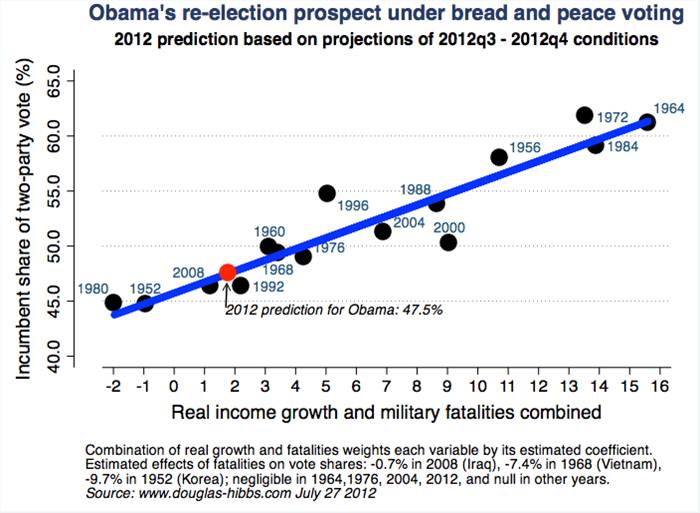
Moreover, as I discussed in this post, Doug Hibbs’  “Bread and Peace” model, which has proved reliable in the past, predicts that Obama will receive just 47.5% of the two-party vote come November. Rather than GDP, Hibbs’ model includes measures for changes in disposal income and American military fatalities.  It is a reminder that there is more than one way to gauge economic fundamentals.

To further complicate matters, according to a recent press release, two Colorado University professors are poised to release their own study purportedly showing that based on state-level economics factors, Romney is going to win 52.9% of the two-party vote, compared to Obama’s 47.1%. I’ve not yet seen the  model on which this forecast is based so I’m not ready to evaluate their prediction, but it potentially provides further evidence that Cook is not entirely off base in arguing that Romney should be doing better in the polls.

My point is that even political scientists are not in full agreement regarding what aspects of the economy are most “fundamental” to presidential election outcomes.  Moreover, each of their forecasts comes with a degree of uncertainty built into their estimates.  This means that, in a close election, forecast models that differ in their prediction regarding the election winner in November could nonetheless all be considered accurate if the final popular vote falls within their specified level of uncertainty.  Of course, this is small consolation to the layperson who wants to know now who the likely winner will be come November 6th, which is what most of you care about!  But it is important to remember that political scientists speak in probabilities, based on past events, not certainties.

So, where does the election stand today?  I would make two points.  First, the median prediction of the econometric forecast models of which I am aware right now hovers just above the 50% mark, suggesting that Obama is a very – emphasis on very – slight favorite. Second, models that include measures of Obama’s approval ratings and/or current national or state-level polling are usually (but not always) slightly more bullish on Obama’s prospects than are models like Hibbs’ that are based solely on the fundamentals.  That suggests to me that that the key question looking ahead is whether opinion polling and Obama’s approval ratings begin to change in ways that indicate that voters,  as they pay more attention to the election, will adjust their views closer to what some forecasters like Hibbs believe the economic fundamentals dictate.  Keep in mind, however, that based on economic fundamentals alone, it is not necessarily the case that Romney should be winning this election.  That assessment depends,  in part, on what fundamentals one includes, and across what time span. And, as my stockbroker I. B. Guessing always reminds me, past performance is no guarantee of future results.

(Note that  many political science forecasters will be unveiling their latest predictions at the 2012 APSA conference which meets in New Orleans next week. When those papers are available, I’ll try to update this post.)

Update 3:24 p.m.  Nate Cohn has an initial and somewhat skeptical reaction to the Colorado forecast I allude to above but again, I haven’t actually seen the specifics yet of their model so I’ll withhold comment for now.  Note that I mistyped their prediction of the two-party vote in my initial post – that’s been corrected.

Of Course The Electorate Is Highly Polarized! (Not)

I’m posting at the Economist’s Democracy in America site today, with an article examining the evidence for whether the American electorate is, as Kevin Drum and other pundits would have us believe, extremely polarized along partisan lines. The short answer, as you’ve heard me state before, is that they are not.

Meanwhile, I hope to  have something up  here tomorrow on the VP sweepstakes.

Stay tuned.

The State of The Race: It Was The Best Of Times. It Was The Worst Of Times.

Today saw two separate and seemingly contrasting assessments of the state of the 2012 presidential election.  First, CNN released its latest presidential poll, and it showed Barack Obama leading Mitt Romney among a sample of registered voters by 52%-47%.  Later, Fox News released its own survey showing Obama up among registered voters by 9%, 49%-40%, over Romney.  At the same time as these generally favorable polls for Obama were released, political scientist James Campbell, in this guest column at Larry Sabato’s Crystal Ball, weighed in with his own assessment of the election that painted a distinctly different picture.   Campbell analyzed two sets of numbers: second quarter GDP numbers in the election year, and GDP numbers for the last 10 fiscal quarters prior to the election in presidencies starting back to 1956 through the Obama administration, and correlated them with elections results.  He found that by both measures the economy under Obama ranks near the bottom of the pack – a finding that, if history holds, does not bode well for Obama’s reelection chances.  As Campbell writes, “If the election becomes largely a referendum on President Obama’s economic record, it is hard to see how he can win. As I have been setting it out in this essay, the record really speaks for itself. It is dismal, and this is without noting the 42 consecutive months and counting of an unemployment rate over 8%.”

How do we reconcile polls results such as those contained in the CNN and Fox surveys that show Obama ahead with the much more pessimistic forecasts by political scientists, such as Doug Hibbs, Campbell and even Alan Abramowitz, based on economic fundamentals?  Bert Johnson and I touched on this topic in our latest professor pundits’ video, but I want to elaborate some of our comments here. In a scholarly article written  in 1993, Gary King and Andrew Gelman examined why trial heat polls like CNN’s and Fox’s can be so volatile in the months preceding a campaign despite political scientists’ claim that election results are largely dictated by fundamental factors that do not change appreciably during the campaign season.   The answer, they suggest, is that many voters who are surveyed several months before an election often really haven’t given much thought to who they will vote for, even though they respond to the question sincerely.   That is, these survey respondents over estimate their own certitude regarding for whom they are likely to vote.  But their answers this far out are often driven by short-term events, such as media coverage of a candidate’s “gaffe”, or more general perceptions regarding who is “ahead” in the race.  These short-term factors, however, are not the ones that ultimately drive the decision for most individual voters.  Instead, that decision will be rooted in the fundamentals, such as economic growth as measured by GDP, as interpreted through voters’ own partisan and ideological lens.

Although their research is dated, I don’t think King and Gelman’s conclusion are any less applicable today, which is why I caution against paying much attention to trial heat polls such as CNN’s and Fox’s at this stage of the campaign. This is even more so for state- level trial heat polls, which is why I am skeptical of efforts to predict the Electoral College vote this far out, particularly since many pollsters’ likely voter screens at the state level aren’t particularly accurate as yet.   More generally, I don’t believe that the relative electoral fortunes of Obama and Romney are fluctuating as much as many voting models based on polling data suggest.

Now, as I have said many times before, when we get closer to the election these polls will become increasingly accurate and they should (fingers crossed!) converge with what the forecast models based on the fundamentals tell us should happen.   Indeed, by the final weeks of the campaign, the polls will be much more precise than our fundamental-based forecast models.   As of now, however, the fundamentals cast a gloomier outlook on the election for Obama than do today’s trial heat polls.  How gloomy? Here, according to Campbell, is where Obama’s 2nd quarter GDP numbers rank among presidents dating back to 1952:

As you can see, only Carter had a worse election year second quarter.  The story is not much better if we look at the average GDP growth for the last 10 quarters; here the GDP figures for Obama are better only than George H.W. Bush’s and the Nixon-Ford quarters.

Note that Campbell doesn’t actual present a forecast in this article.  In past years, however, he has presented a forecast model in early September based on GDP 2nd quarter growth and Gallup Poll trial heat polls from Labor Day, and I expect he will do so again in a matter of weeks. In previous elections this model has done quite well predicting the winner’s share of the two-party vote. Like all forecast models, however, it is not foolproof; in 2008 Campbell was the only political scientist to my knowledge who forecast a McCain victory (with 52.7% of the two-party popular vote).  Ironically, Campbell blames his failure to forecast Obama’s victory on one of those “black swan” events that political scientists always say can throw a forecast off, but which never seem to appear.  In 2008, however, if Campbell is to be believed, it did appear in the form of the Wall St. meltdown. As Campbell wrote in his election post-mortem (gated): “Unlike any election in modern history, the 2008 campaign had been derailed by an entirely unanticipated and unpredicted external event.”    But, given this unprecedented fiscal meltdown, why did the other forecast models successfully predict Obama’s victory and come much closer to estimating his share of the two-party vote?  Campbell says, in essence, that they were lucky:  “Under the circumstances, I think that whether a forecast was close to or distant from the vote this year is largely a matter of good or bad luck.  Nothing in any of the models would have either directly or indirectly anticipated the effects of the timing of the Wall St. meltdown.  Nothing.”

Not all forecasters would agree.  As I noted in an this earlier post discussing Doug Hibbs’ forecast model, Hibbs has no use for models like Campbell’s that incorporate trial heat polls or presidential approval ratings because they are essentially adding “noise” the forecast, since both approval and trial heat results are themselves predicated, at least in part, on the economic fundamentals.

So where does that leave the race?  In my view, the fundamentals that have generally proved reliable in the past suggest that come November, this race will be much closer than the margin suggested by today’s CNN and Fox polls.  Although you will undoubtedly hear pundits proclaiming in the wake of these latest polls that we are seeing a potential turning point in the race, with Obama beginning to stretch his lead, the King and Gelman study reminds us that this type of polling volatility is par for the course and likely does not provide a very reliable preview of November’s outcome.

The 2012 Presidential Election Is Most Like This Previous Election

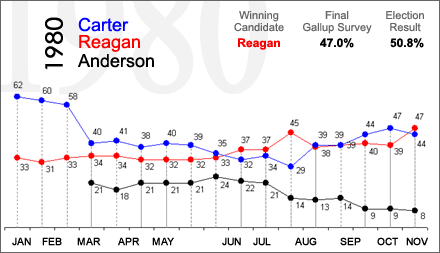
One of the recurring exercises in any presidential election year is the effort by pundits to find the most appropriate historical analogue among previous presidential elections.  What is deemed “appropriate”, however, is usually determined by whether the historical antecedent favors your preferred candidate.  This election cycle has been no exception.  Democrats see strong parallels between the current race and the 2004 contest between John Kerry and George W. Bush.  Although Kerry actually led in some early polls, the election remained quite close until Bush, the first-term incumbent running for reelection, pulled it out with slightly more than 51% of the two-party popular vote. Not surprisingly, Romney supporters don’t believe 2004 has much to say about this election. Instead, they point to 1980, when Ronald Reagan trailed Jimmy Carter in the Gallup Poll for much of the post-Labor Day period only to surge ahead in the closing week, as the most fitting historical parallel.

In this vein, Greg Sargent, writing in yesterday’s Plum Line column for the Washington Post, took issue with the 1980 comparison for several reasons.  The first has to do with the difference in candidate qualities; Sargent writes:   “Reason one: Obama is a better and more likable politician than Jimmy Carter was, and Romney has not proven himself to be Ronald Reagan.”  As evidence, Sargent quotes long-time GOP strategist Ed Rollins who notes that Romney is no Reagan: “There’s no question that on his best day, he’s not a Ronald Reagan…. Traditionally incumbents don’t do as well in debates as challengers for the simple reason that challengers have to stand on the stage and look like an equal. Romney can do that, but Obama is good. He’s likeable. Carter was never likeable.”

If asked, I think many pundits would agree with Rollins’ characterization of Carter; he was the moralizing, preachy politician who – with a smugness bordering on arrogance – castigated Americans for their “crisis of confidence”.   It was small wonder that he was viewed as so much less likable when compared to Reagan – the eternal optimist who spouted homilies about America as the shining “city on a hill”.  Not surprisingly, Reagan pulled ahead after their one and only debate in late October, largely because voters had a stronger personal affinity with  Reagan.  The lesson?  Reagan’s sunny optimism trumped Carter’s dour moralizing.

Alas, Rollins has the story completely backward, as Mo Fiorina reminded us earlier in this this New York Times editorial which I’ve discussed before.    Rather than being disliked, on a personal level Carter was held in far higher regard than Reagan in the eyes of most voters – indeed, despite his low job approval, Carter had the highest-rated personal qualities of any Democratic candidate in the period from 1952-2000, and Reagan had the lowest of any Republican presidential candidate. As Fiorina summarizes: “The Ronald Reagan of October 1980 was not the Reagan of “morning again in America” in 1984, let alone the beloved focus of national mourning in 2004. Many Americans saw the 1980 Reagan as uninformed, reckless, and given to gaffes and wild claims. But despite their misgivings about Reagan, and their view that Carter was a peach of a guy personally, voters opted against four more years of Carter.”

As is often the case, the prevailing view of Carter as unlikeable likely reflects a post-hoc rationalization for why he lost the election, as well as eight years of a largely successful Reagan presidency.  But that’s not how the two candidates were viewed in the run-up to the 1980 election – something Rollins evidently forgets.

But perhaps there’s a second good reason why this year isn’t like 1980? Sargent, again citing Rollins, argues: “Reason two: The electorate is far more polarized now. Rollins notes that a last-minute shift was enabled by the larger role Dem swing voters played at the time. ‘There was a big swing element in the Democratic Party — blue collar Democrats,’ Rollins noted. ‘It’s smaller now.’

Again, I think this analysis is at least in part wrong; as I’ve argued in many previous posts (see here, for example) there’s not much evidence that the electorate is more polarized now than in previous elections.  What has changed is that the choices have become more polarizing.  This may make it less likely that voters of one party will consider voting for the opposing party’s candidate.  But it does not mean that there are not enough undecided voters left to preclude a small shift toward Romney in the closing weeks of this race – and in a tight race, a small shift will be enough.

Is that likely to happen?  I don’t know.  But if it does, it almost surely will have little to do with which candidate is more likeable and instead will turn on more deep-seated voter concerns regarding which candidate is better able to resurrect a moribund economy.  In this respect, 2012 has a lot in common with 1980 – and with 2004 – and with most of the presidential elections in the post-World War II era.

3:45 p.m. I’ve added a link to the Gallup data showing Carter leading Reagan during most of the post-Labor Day general election campaign until Reagan surges near the end.  Note that the race was quite tight for most of this period, according to Gallup.