Tags » Web Application Development


New Plugin for WordPress: Show Thumbnails in the Posts List

Categories: LIS Staff Interest, Middlebury Community Interest

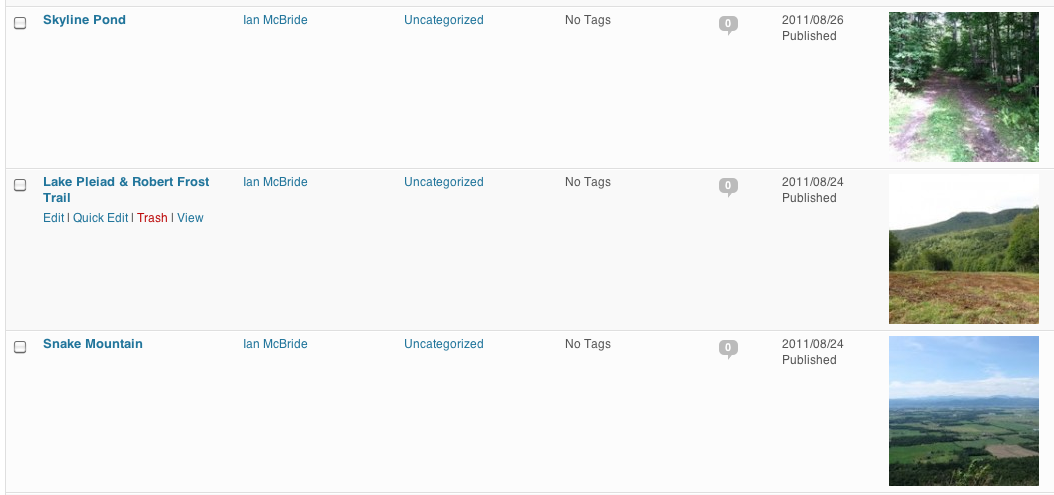
If you use Featured Images for posts in your WordPress site, you can now enable a plugin for your site that will show these images to you on the All Posts page in the administration interface for your site. This can help you quickly identify posts in the list. The name of the plugin is “Midd Post Thumbnails”. Simply activate it on the Plugins administration page and your posts list will now look something like this.

Easy Navigation Links For On-Campus Browsing

Categories: LIS Staff Interest, Middlebury Community Interest

If you are browsing our website on-campus through an ethernet connection or connected to the midd-secure or midd-standard wireless networks, you should now see three links in the top-left corner of any page on www.middlebury.edu. If you are browsing from off-campus, you can log in to the site to have the links show up. These links will let you quickly get to WebMail, BannerWeb and the Portal.

If you’re on-campus you can also get to these resources by typing mail, go/mail, go/email, go/webmail to get to WebMail; go/bw or go/bannerweb to get to BannerWeb; and portal, m, students, facstaff, staff, faculty, go/portal, go/m, go/facstaff, go/students, or go/faculty to get to the Portal. Searching for any of these terms will also bring you directly to these sites and the links to them remain in the site footer. You can also customize how and whether they appear for you in the Portal.

Thanks also to Adam Franco for setting up Edge Side Includes so that we can show custom content to on-campus people while still delivering a cached copy of the page to make your browsing experience faster.

New Portal Customizable Links and Feeds

Categories: LIS Staff Interest, Middlebury Community Interest, Post for MiddNotes, Post for MiddPoints

We’ve just finished adding some new features to the portal and mobile site. You can now add to, and remove links from the links module. In addition, there is a new module “My Feeds” which will generate an aggregate (combined) feed of any feeds that are added to the module. Details are available in the documentation that is available on the wiki.

WRMC added to the Portal and Mobile site

Categories: LIS Staff Interest, Middlebury Community Interest, Post for MiddNotes

You can now listen to WRMC 91.1 FM on the go, anywhere in the world on your mobile device and computers. Both the High Quality (192k) and Low Quality (96k) streams are available by clicking on the WRMC logo on the mobile dashboard or hovering over the icons at the top of the portal to see the WRMC option which appears in the second row. Remember, you can use the portal customization features to move it up in the list if you want to make it even easier to find.


Top Picks from DrupalCon 2012 Denver

Categories: LIS Staff Interest

We (Adam and Ian) were in Denver, Colorado this week attending the annual US Drupal convention. In addition to attending sessions, we were able to connect with colleagues from other institutions including Amherst, Wellesley, Lawrence University, UNH, and CSUMB. We sponsored a “birds of a feather” session, with Amherst, to introduce interested parties to Monster Menus, a Drupal module that Amherst and Middlebury use to add a site hierarchy and manage permissions on our site. This session was surprisingly well attended by about thirty participants and we had a lively discussion about Monster Menus’ capabilities and limitations. We also attended multiple sessions on using Drupal in higher education to hear what people at other schools were doing with the platform.

All of the sessions can be watched on the conference website (use the tabs across the top to browse each day’s sessions). Adam and I will highlight some that we found especially engaging, but if there’s one we missed that you think others would enjoy, please share it in the comments.

Keynotes

Dries Buytaert: Dries is the guy who created Drupal and currently runs the leading Drupal consulting business and serves as President of the Drupal Association. His talk covered where the development team is focusing for the Drupal 8 release. There are three main areas of focus, (1) mobile compatibility, (2) modernizing the development API with the Symfony framework, and (3) improving the user interface for content authors. He announced a tentative release date of August 2013 for Drupal 8.

Mitchell Baker: Mitchell is the “Chief Lizard Wrangler”, the head of the Mozilla project that produces the Firefox browser and Thunderbird email client among other efforts. She talked about the “Maker Ethic” and how the goal of Mozilla it to enable and promote the freedom to create, write, and publish. As she describes, the Firefox browser is but one product to enable this freedom and only one of the many projects Mozilla is engaged in.

Luke Wroblewski: Luke gave a very entertaining presentation arguing that we now need to develop web applications for mobile devices first and worry about the desktop experience second. He presents amble data backing up this assertion, which is guiding the mobile-first goal for Drupal 8. Adding responsive designs for mobile interfaces to our platforms is a 2012 goal for the Web Applications Development workgroup here, so we’ll be doing a lot of work in this space shortly.

Ian’s Picks

Designing Fast and Beautiful Maps: This talk describes the TileMill and MapBox mapping tools, showing how you can transform a simple spreadsheet into an interactive map interface that can easily be added to a Drupal site (or any other website). Though this is probably not something that we’d use for the main campus map it looks like a great tool for one-off mapping projects including student research. By the way, if you have a map that you’d like us to feature on the site or in MiddLab, contact me and I’ll be happy to help you get that map online.

I just want to edit a node and Five things we need to create an awesome experience for content creators: These discussions describe the initial thinking about the user interface for content creators in Drupal 8. While we won’t be moving to that platform until late 2013/early 2014, and some of the decisions about the platform may very well change by then, this is an early warning about what to expect. I should note that some of the features they discuss, like inline editing, are already available to us thanks to the Monster Menus module developed by Amherst.

HTML 4 S – While We’re Waiting for the Revolution: We spent a lot of time thinking and talking about adding HTML5 features to our sites, but that’s not always possible due to assumptions made by the back-end systems as well as browser compatibility. This talk discusses the steps we can take to get “close enough” on HTML5 adoption and some of the pitfalls we’ll encounter that are specific to Drupal, though much of the information here is Drupal-agnostic. I’ll give a small warning that the speaker is quite colorful and animated in his speech.

Adam’s Picks

Real World Performance Analysis: How to Identify Performance Problems in Your Own Sites: This talk provides a good strategy for tackling performance issues in Drupal sites without wasting time on optimizations that won’t have a big impact.

Keeping The Lights On – Operations and Monitoring Best Practices:  This session is focused on practical tools and techniques you can use to keep “your fingers on the pulse” of your site, from availability to performance to security.


Also, we were able to enjoy Colorado for a bit before the conference.

Looking forward to next year in Portland, Oregon, or perhaps Munich or São Paulo later this year!

Supported Web Browsers

Categories: LIS Staff Interest, Middlebury Community Interest

For an updated list of currently supported browsers, see the Web Application Development website.

I was asked by a member of the LIS Website Team to update a post from two years ago on supported web browsers for our site. In general our guideline for supporting a browser is to keep support for it for as long as the browser’s manufacturer is supporting it. This means we will try our best to resolve issues with any browser that you can readily download from a manufacturer’s site, except for beta and pre-release versions.

These guidelines apply only to services supported by the Web Application Development workgroup. Other workgroups may have their own guidelines, for example Internet Explorer 7 and 8 are the only supported browsers for Internet Native Banner and Hyperion users.

These are the versions we support at the time of this post (alphabetically):

With the exception of Internet Explorer, each of these browsers have both Mac and PC versions.

I’m using internet explorer, which version should I use?

Most of the site’s features and visuals are the same in IE 7 and IE 8, but IE 8 does have a better rendering engine and will be able to support more features going forward. IE 8 also loads pages faster and processes JavaScript faster because any time a script tries to access an element on a page in IE 7 it has to scan the entire page. IE 8 stops scanning the page after it finds what it’s looking for. As a result, IE 7 users have fewer stories available to them on our homepage because the browser isn’t fast enough to process them all, so we randomly cut some out.

Users of Internet Native Banner and Hyperion should stay on IE 7 or IE 8, since those are the versions of Internet Explorer supported for use with INB and Hyperion.

If that doesn’t apply to you, IE 9 has some interesting features, but is only available on Windows 7. The most important is that it supports HTML5 elements, including the audio and video tags. IE 9 users are able to play these elements on our site using their browser’s built-in media player while IE 7 and IE 8 users will see a Flash-based player instead. I’m working on rolling out more HTML5 features on our site like form validation, date pickers, local storage, and location services that will make the site a bit faster and slicker for people using browsers that support these features.

What about older versions of other browsers?

Security updates for Firefox, Chrome and Safari are only released for the latest version, so I recommend that you turn on automatic updates for these browsers.

The Mozilla Foundation makes available all older versions of the Firefox browser, but after a certain time stops applying security and stability updates to the browser. For instance, this is scheduled to happen to Firefox 3.6 on April 24, 2012.

Is there a different list of supported browsers for editing www.middlebury.edu?

No. The only difference is that Internet Explorer and Firefox 3.6 users can only upload one file to the site at a time. Other users can select multiple files and upload them as a batch, which saves a bit of time. Firefox 3.6 users should update to the latest version of Firefox. The feature is currently not available in any version of Internet Explorer, but will be added to Internet Explorer 10 when that browser is released.

What about beta and pre-release browser versions?

You’re welcome to use these, and they may work, but we will not respond to bug reports about site functionality not working in a beta version of a browser. These are often caused by issues with the browser that are addressed before its final version is released and third-party systems like WordPress and Drupal will often release their own fixes to these issues when the final version of a browser is released. It’s not efficient for us to spend time addressing these issues as well.

I’m using one of the supported versions, but there’s an issue. What can I do?

You can email the Helpdesk, call the Helpdesk at x2200, or submit the Web Feedback form and we’ll get in touch with you via email.

What are the stats on browser usage of the Middlebury website?

Browser All Internal External
Safari 34.12% 36.69% 32.36%
Firefox 23.62% 25.18% 22.53%
Internet Explorer 22.92% 19.85% 25.04%
Chrome 17.31% 17.58% 17.11%

The Android Browser, Opera, IE with Chrome Frame, Opera Mini, and the BlackBerry8530 browser account for under 1% of our site visits. Of the people using Internet Explorer, here’s how many are using each version. If you’re one of the 1.14% of internal users still on Internet Explorer 6, please contact our Helpdesk.

Browser All Internal External
Internet Explorer 6 1.26% 1.14% 1.33%
Internet Explorer 7 21.21% 36.42% 12.86%
Internet Explorer 8 56.45% 57.29% 55.99%
Internet Explorer 9 21.07% 5.15% 29.81%

If I haven’t answered your question here, leave a comment.

Upcoming MediaWiki Changes

Categories: LIS Staff Interest, Middlebury Community Interest

We will soon be updating MediaWiki to the latest stable version, 1.18.1. While there are many changes behind the scenes with this update, the most visible change is that the what-you-see-is-what-you-get (WYSIWYG) editor, FCKeditor, is no longer supported by its authors and will not run in either of the two latest versions of MediaWiki.

In its place we have added the WikiEditor, the default editor on Wikipedia, which helps users insert proper wiki markup into pages:

Please try out the new editor in our testing sandbox (available only on campus or via the VPN) and let us know how it works for you in the comments below.

While it isn’t WYSIWG, new editor has the following benefits:

  • It won’t corrupt some pages like the FCKeditor would when certain formatting was used.
  • The included ‘Preview’ and ‘Changes’ tabs let you quickly view the results of your changes without saving.
  • Your Wiki-editing skills can be used on Wikipedia and any other MediaWiki wiki.

Middlebury’s Web Presence – a few high level snapshots

Categories: LIS Staff Interest, Middlebury Community Interest, Post for MiddPoints

The Wayback Machine can give us a  glimpse into the world wide web of the past, and there you can see snapshots of Middlebury’s early web sites as far back as 1997 with some data on web traffic as far back as 1995. If you go to the Web Application Development group’s web site, you will see a slide-show of how our main site has changed visually over the years.

In those days, most of the content was delivered using html pages, content that stood alone on a single file, maybe pulling in some images or linking to a clever cgi script that powered a guestbook. Over the last seventeen years Middlebury College has seen this grow from many linked pages to many linked platforms, sharing information across many sites and systems, making up our web presence. More