As new students arrive at college campuses everywhere, we all know the first thing they do is … check out their library’s web page (go/library)! More
Based on the findings of an assessment we did last spring (thanks to all students who answered our survey questions!), we’ve decided to use the Reference Desk again. This is the tall desk on the main level of the Davis Family Library, near the walk-up computers. Don’t get used to the name though. We’re changing it! We’re also stretching to increase our hours of coverage. When students work with us, they come back. But some students don’t think of us in the first place. We’re trying to make it easier for all students to ask us for help. (Note: We often have candy!)
Librarians are now available at the Research Desk. Please bring your research questions to us! Does the library have any movies in Spanish? How should I cite this web page? I’m writing a paper on [insert your topic here]… We know what to do!
Hours:
Monday-Wednesday: 11-5 and 7-10 pm
Thursday: 11-5 pm
Friday: 11-4 pm
Sunday: 1-5 and 7-10 pm
At any time you can always Ask a Librarian! (go/askus)
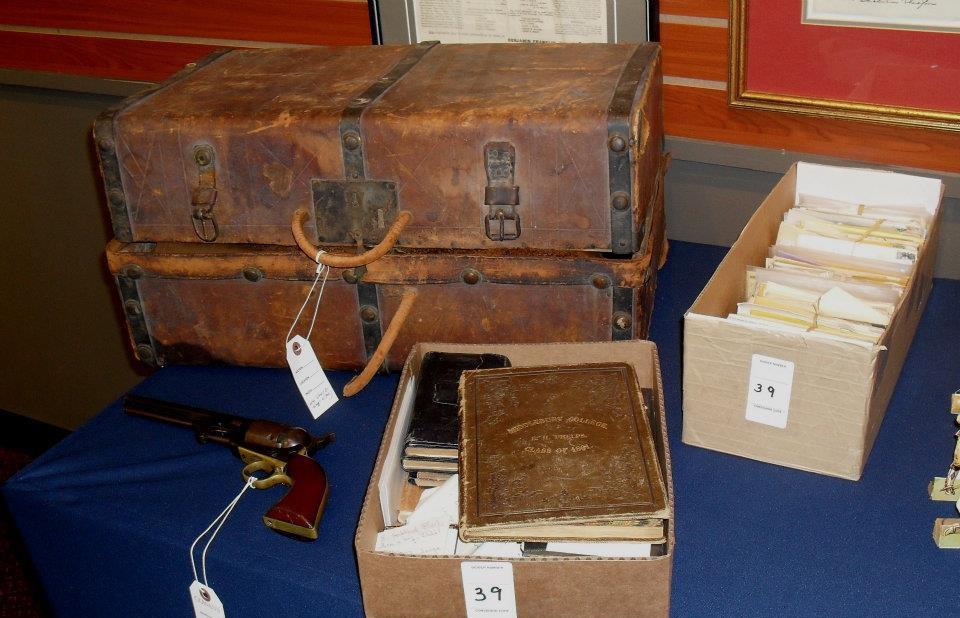
The winning bid on the Archive of Civil War paymaster Erastus Hibbard Phelps, Middlebury Class of 1861, was made at auction by Andy Wentink, Curator of Special Collections & Archives. The archive was one among nearly 350 lots of American History, including Civil War, materials offered by Cowan’s Auctions in Cincinnati, OH, last Friday morning, December 2. The Phelps Archive comprises 334 letters, 4 diaries (3 from Civil War years), 2 bound volumes including a photo album containing portraits of graduates of the Middlebury Class of 1861, many of which are inscribed to Phelps. The archive also includes two photos of Phelps previous to his years at Middlebury, his paymaster sidearm (a Colt 1851 Navy 36 caliber pistol), what is believed to be his sheepskin winter jacket worn on duty, and a leather documents trunk carried during his service.
Behind the Scenes: A Window into History created by Sara Marshall, Stephen Diehl, and Brendan Mahoney ’11, of College Communications for the online edition of Middlebury Magazine. We’re very pleased with and honored by the film.
Carrie, Jess and I traveled to West Lebanon on October 21st for the 2011 October Conference presented by the Dartmouth Biomedical Libraries. We learned how other libraries are promoting their resources and we presented a session about some options we use here. To find out more, link to our report.
With the merger of Collection Management and portions of Academic Consulting Services, it became clear that the area needed a new name to reflect its expanded scope.
I’m therefore pleased to announce that the name for this area is now Research and Collection Services (RCS). While many portions of the website still reflect the old names — and it will take a while before we’ve eradicated all remnants of Collection Management/Academic Consulting Services from the website, email distribution lists, HR/Banner information, etc. — please consider the name to be effective immediately. We’ll try to get the changes made expeditiously.
As a reminder, RCS includes:
The library recently added a subscription to Social Explorer, which provides easy online access to demographic information about the United States, from 1790 to present. It allows for the easy creation of thematic maps and downloading into other software products such as PowerPoint. It also provides convenient digital access to two censuses never before available online: 1970 and 1980.
Jason Mittell (Film & Media Culture), James Morrison (Political Science) and myself lead a workshop for faculty on taking notes and grading digital documents yesterday that was well attended (see: Moving Away from Paper: Useful Practices for Electronic Note-taking and Grading Assignments).
Jason and James described how they assigned and collected students papers. Both used email as the primary means of collecting assignments from students for the following reasons:
James and Jason differed in the format they required their students to submit assignments and the tool they used to annotate and grade these assignments. Read more about their annotation and grading workflow on the Teaching with Technology blog (see: Moving Away from Paper: Annotating and Grading Digital Documents – Jason Mittell & James Morrison)
Both James and Jason have also had their student use Google Docs for collaborative projects. Unfortunately Google Docs does not support footnotes so that is cannot be used as a tools for writing scholarly papers. That said, Google Docs may be a good tool for creative writing classes or for language classes.