The Four Main Tones
When Chinese want to emphasize the right tone they pronounce a syllable slowly.

Tone 1 is pronounced evenly and with a rather high voice, a bit like a soprano singer who sings the same sound for a long time while letting it fade. We have chosen the color red for this tone as it fades away like the red sun in the evening.
Tone 2 goes up as if someone was asking something. One can also compare tone 2 to the sound of a motorcycle which accelerates and changes gears. After each change of gears, a new tone 2 starts. We have chosen the color yellow as the sun is usually yellow when it comes up.
Tone 3 falls firstly and then it rises. This is quite strenuous for which reason the Chinese pronounce a distinct falling and rising sound only if they want to emphasize the tone 3. Yet, during an everyday conversation, tone 3 is simply pronounced a bit deeper than the other syllables. So, don’t get confused by tone 3. The rule of thumb is: Tone 3 is deep. If you focus on that, you will be well off! We have chosen green for tone 3 as grass grows on the ground.
Tone 4 is short and falling, like a sigh. At the start of a tone-4-syllable, the voice is high. Then it falls quickly as if someone was sighing quickly and vigorously. The blue color stands for water which always flows downwards.
Don’t think that the tones are extremely diffucult! If you can differentiate between a soprano singer, a motorcycle, a deep voice and someone sighing, you can also differentiate between the four tones in Chinese!
Our ears are well trained to hear differences in tones. In English, we use different tones in order to communicate that we want to ask something. Compare the following two sentences: You did this! You did this? Speak the two sentences aloud! The only difference is the tone! So, we use different tones in English too! We just have to use our capability to hear different tones in English in a different way when we listen to Chinese. It took us several years to learn our mother language. So, why should we get desperate if it takes us a few hours in order to develop a sense for the different tones in Chinese?
Overemphasized Tone 3
Sometimes Chinese overemphazise tone 3 and by doing so they actually pronounce two tones, a falling one and a rising one with a short pause in between. This way of pronouncing tone 3 is helpful if one wants to make sure that the counterpart definitely hears tone 3. Yet, this is kind of a “street Mandarin”. In the following illustration, we show you this way of pronouncing tone 3.

Quickly Spoken Syllables
In conversations, the Chinese pronounce the tones shortly and they don’t emphazise tone 3.

As a rule of thumb one might memorize:
Tone 1: high
Tone 2: rising
Tone 3: deep
Tone 4: falling
Tone 5
Tone 5 (black) is the neutral tone. A syllable with a neutral tone doesn’t have a fixed pitch. It is rather adopting the tone of the preceding syllable while letting the respective tone fade. In addition, a tone-5-syllable is pronounced rather shortly. In the following illustration, you see the tone of a preceding syllable (colourful) and the tone of the neutral syllable (black).

If another syllabe follows tone 5, tone 5 is kind of a springboard for the tone of the following syllable.
Tone 3 + Tone 3 Changes to Tone 2 + Tone 3
If two syllables in tone 3 follow eachother, the first of the two syllables changes to tone 2. This makes sense as it is quite strenuous to pronounce two tone-3-syllables one after another.
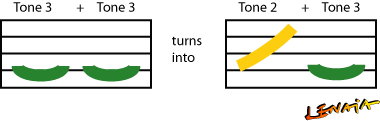
Example: 你好 ( nǐhǎo, hello) is pronounced níhǎo (= ni2hao3).
Tone Changes of 一 (Yī One)
一 (yī one) means “one”. This word is quite frequently used in different combinations. The tone of 一 (yī one) changes when it appears in combination with other characters.

Example 1: 一些 (yīxiē, some) is pronounced yìxiē (yi4xie1).
Example 2: 一齐 (yīqí, together) is pronounced yìqí (yi4qi2).
Example 3: 一点 (yīdiǎn, a little) is pronounced yìdiǎn (yi4dian3).
Example 4: 一个 (yīgè, one) is pronounced yígè (yi2ge4) .
As a rule of thumb you might memorize: 一 (yī) is pronounced as yì (yi4) when it is used in combination with another character.
Tone Change of 不 (Bù Not)
The tone of bù (bu4) changes if another tone-4-syllable follows:

Example: 不对 (bùduì, not correct) is pronounced búduì (bu2dui4).
3-Character-Phrases
If the characters 一 (yī one) and 不 (bù not) stand between other syllables which belong to the same phrase, they take on the the neutral tone which means that they adopt the tone of the preceding syllable while serving as a kind of springboard for the tone of the next syllable.
The following illustration might be a bit confusing at first sight. Yet, it illustrates how the tone of 一 (yī one) becomes a neutral tone which means that it can adopt every tone by building kind of a “tone connection” between the the tone of the preceding character and the tone of the following character.
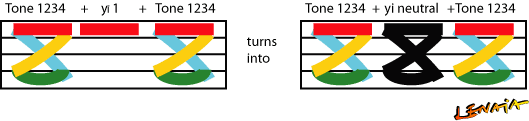
Example: 另一个 (lìngyīgè, another) is pronounced lìngyígè (ling2 – yi toneless – ge4).
The same thing happens to 不 (bù not) if it is part of a three-character-phrase.

Example: 对不起 (duìbuqǐ, sorry) turns into duìbuqǐ (dui4 – bu toneless – qi3).
Now, you know all about the Chinese tones and the tone changes. Don’t spend too much time on the tone changes in the beginning. Just remember that they exist and don’t become confused if you hear a 一 (yī one) or a 不 (bù not) pronounced with a different tone!
cited from: http://www.lenaia.com/learningchinesepinyinpronunciation/pinyinpronunciation/learningchinesepinyinpronunciation.php