Tag Archives: Translation

Found In Translation Lecture: The Translation Industry and University Translation Programs in China by Benjamin Zeng

The 8th lecture in the Found in Translation series

When: Tuesday, November 16.  12:15 – 1:45 in Irvine

Speaker: Dr. Benjamin Zeng, Professor of the College of Foreign Languages at Zhejiang Normal University.

Lecture Title: The Translation Industry and University Translation Programs in China

The lecture will give an overview of the status quo of the translation industry in China (company structure, technology use, content domain, pricing, etc.), the plight of the translator, and university translation programs.

An Interview with Zinan Ye

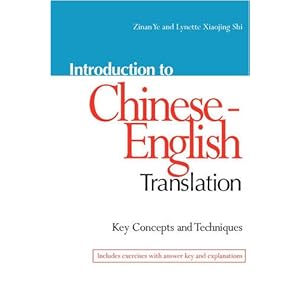
In September, MIIS Professor Anthony Pym interviewed MIIS Professor Zinan Ye, who teaches Chinese translation and Chinese site translation.  The interview discusses Zinan Ye’s popular column in the Chinese Translation Journal in China, as well as his books: The Theory and Practice of English-Chinese Translation (published in Taiwan and Beijing),  A Dialogue on English-Chinese Translation (published by Beijing University), and Introduction to Chinese-English Translation (published in New York and to be published in Taiwan — coauthored with Lynette Xiaojing Shi).

Photo: amazon

The interview also discusses how Professor Ye got from being a freelance translator in China without formal training to where he is today at MIIS.  In the latter part of the interview, Ye discusses the current situation of translator training in China, as well as the recent increase of Masters in Translation and Interpretation Programs in China, and he also gives his views on translation studies and translation research in China and his opinion on the Eurocentricity of the translation field.

Found in Translation Lecture: Interpreting for the US Dept of State by David B. Sawyer

The 7th Found in Translation lecture series

When: Monday, November 8, 6:00 – 7:30 in McGowan 102

Speaker: Dr. David B. Sawyer, Chief of the European Languages Branch and Senior Diplomatic Interpreter for German in the Office of Language Services at the United States Department of State. Previously, Sawyer was a freelance conference interpreter and Associate Professor of interpretation and translation at the Monterey Institute of International Studies, where he was head of the German program. He was on the faculty at the University of Mainz in Germersheim, Germany, where he earned graduate degrees in conference interpretation, translation, and a doctorate. He is a member of the International Association of Conference Interpreters and the author of Fundamental Aspects of Interpreter Education: Curriculum and Assessment.

Title of Lecture: Interpreting for the United States Department of State: History and Current Practice

The mission of the Office of Language Services (LS) of the United States Department of State is to facilitate communication with non-English speaking governments and people by providing high-level interpreting and translating support to the Executive Office of the President, the Department of State, and other agencies of the United States Federal Government. The Office of Language Services carries on a tradition of language support for the conduct of foreign policy that dates back to 1789, when it was founded by Thomas Jefferson, the first Secretary of State of the United States of America. This presentation outlines the history of LS, looking in particular at the development of diplomatic interpreting and its current practice. The views and opinions expressed are strictly those of the speaker and do not necessarily represent those of the U.S. Government or the U.S. Department of State.

TIJ 25th Anniversary Symposium on Translator and Interpreter Education

On June 20, 2010, the MIIS Translation and Interpretation Program in Japanese (TIJ) program held  its 25th Anniversary Symposium on Translator and Interpreter Education at the International House of Japan in Tokyo.

The 4-hour symposium began with greetings and a presentation by Professor Kayoko Takeda, entitled “The Future of Translator/Interpreter Training at Higher Education” and included the history of TIJ.  Dr. Winter then gave a short talk about how TIJ began at the Monterey Institute.

Following the presentation, an Interpreter Panel consisting of three alumni and one former visiting scholar and moderated by Takeda discussed the current interpreting markets and what they expect of interpreter education programs in the future.

The was also a Translator Panel moderated by Professor Tanya Pound, consisting of three alumni and one former visiting scholar, which similarly discussed the current translation markets and what they expect of translator education programs.

A teacher panel was also moderated by Takeda, which included four current and former MIIS faculty members, an alumnus, and a Translation and Interpretation agency rep.  They discussed the future of translator/interpreter education in response to the discussions by the previous panels.

The symposium resulted in many good discussions, including an interesting discussion of how machine translation, translation tools, and crowd sourcing may affect the practice and training of translators.

The 108 attendees were comprised of 44 alumni, 3 faculty (Takeda, Pound, and Winter), 9 prospective students, 1 staff member (Leah Gowron), and 51 guests, including former faculty members and visiting scholars, university professors, translators and interpreters, and TI agencies. One notable attended was Mr. Koichi Ishiyama (Midd 1969), a renowned author of very popular Japanese – English dictionaries.

Many of the attendees enjoyed the symposium so much that they asked when another similar event would be hosted, and some alumni started discussing the possibility of organizing a TI seminar series in Japan. After the symposium was completed, more than 50 people attended a reception at a restaurant in Roppongi.

The symposium could not have been such a success without the help of sponsors Honda Kaihatsu Kogyo and Creer and Communicators and we thank them for their support!

MIIS Info Session in Korea

On July 4, 2010, Professor Miryoung Sohn offered a talk in Seoul, Korea for alumni and forty-six prospective MIIS students.

Recent T&I graduate, Shihee Yu emceed the 2 hour event.  The information session began with a general introduction to MIIS and followed with testimonies from a number of MIIS alums about their degree experiences and careers since leaving the Institute.  Among those giving testimonies were two 2005 International Policy Studies graduates, Katie Klemsen and Nicola Kim and three Korean T&I graduates, Hyunsuk John Lee of class ‘03, Aeree Park of class ’02, and Jiyoung Park of class ’09 for MACII and ’10 for MATFL.


The prospective students were introduced to the T&I curriculum and the MIIS application process, and the session ended with a chance for the students to ask their questions about the Monterey Institute and its programs.  The session was well-attended, with 46 prospective students and 10 Korean T&I alumni at the event.  Following the information session, there was an alumni dinner.

Professor Uwe Muegge introduces TermWiki to a global audience

While most practitioners in the language business understand the critical importance of managing terminology, very few translators, let alone interpreters, actually create comprehensive, project-specific dictionaries. One of the reasons for this phenomenon is the lack of powerful, easy-to-use, low-cost tools for collecting and maintaining multilingual vocabulary. TermWiki, a new web-based terminology management solution developed by CSOFT in collaboration with professor Uwe Muegge, is a free community solution that allows global organizations as well as individual freelancers to manage term collections of any size without installing or buying any software.

muegge termwiki

After presenting TermWiki to the academic community at the Leipzig International Conference on Translation Studies (LICTRA) last month, Uwe Muegge has been invited by the publisher of tcworld to contribute an article on TermWiki and collaborative terminology management to a special print issue of the online magazine tcworld. In his fourth publication this year, Muegge discusses the implications of not managing terminology in the context of a large, multilingual translation project, and how TermWiki revolutionizes authoring, translation, and review processes.

Computer-Assisted Translation De-Mystified!

Since 2008 Professor Jon Ritzdorf has taught intensive, non-degree, workshops on Computer-Assisted Translation  to rave reviews. “Making the complex simple and fun,” is Jon’s motto, and his energetic and hands-on teaching style keeps everyone engaged, and leaves no translation professional behind.    CAT tools allow translators to access  prior translations, thus saving time and helping them to work more efficiently.   In fact, the Monterey Institute requires all of it’s translation and interpreting MA students to take basic CAT, as we feel the ability to use such software is fundamental for all translators.

Professor Jon Ritzdorf coaches translation professional

Professor Jon Ritzdorf (left) coaches a translation professional

This CAT workshop is ideal for working translators who may feel intimidated by technology, and who have not yet made the switch to using  CAT tools. Workshop participants become familiar with the concepts behind CAT, so they can feel comfortable using any tool on the market. Translators who have tried (perhaps, unsuccessfully!) to self-teach using software manuals greatly benefit from these hands-on workshops.   To be on our mailing list for upcoming workshops, contact Rachel Christopherson at: rchristo@miis.edu

Issues In Re-Translation: The Case of Celestina by Peter Bush

On April 1, 2010, Peter Bush, an award-winning literary translator living in Barcelona, discussed his new translation of Fernando de Rojas’s Renaissance masterpiece, Celestina. This translation re-asserts Celestina‘s power as a pioneering work of fiction, written over five hundred years ago in a language and mood that is thoroughly contemporary. De Rojas’s original mix of street wit, obscenity and cultured rhetoric mark Celestina as one of the first prose masterpieces of European literature and a work of art to rival Cervantes, Velázquez and Goya. In his talk, Bush examined the tradition of translating this classic and discussed the strategy informing his decision to dispense with the dramatic structure imposed by de Rojas’s original publishers at the end of the fifteenth century. He compared different versions of a specific extract in English and French to facilitate a critical exchange on the theory and practice of translation.

Peter Bush studied French and Spanish at Cambridge and researched Spanish fiction and history in Oxford. He was Professor of Literary Translation at Middesex University and at the University of East Anglia where he also directed the British Centre for Literary Translation. Recent projects include Juan Goytisolo’s Juan the Landless, Valle-Inclán’s Tirano Banderas and Najat El Hachmi’s The Last Patriarch. He edited The Translator as Writer (with Susan Basnett), a collection of essays by leading translators on the art of literary translation.

     Celestina by Fernando de Rojas, introduction by Juan Goytisolo, with an after word by translator, Peter Bush. Published by Dedalus Books (June 2009) and Penguin Classics USA (January 2010)

Celestina by Fernando de Rojas, introduction by Juan Goytisolo, with an after word by translator, Peter Bush. Published by Dedalus Books (June 2009) and Penguin Classics USA (January 2010)

Fernando de Rojas was born in La Puebla de Montalbán in the early 1470s into a family whose Jewish forebears had been forced to convert to Christianity.

GSTILE Lecture Series Features Architect of Windows 7 Global Launch

Ulrike Irmler, Principal Group Manager at Microsoft, discussed the complexity of a worldwide, simultaneous software launch that involved more than 90 languages. In her presentation, Ms. Irmler talked about the different audiences the

Microsoft operating system has, and how this diversity requires multiple, customized localization strategies. This presentation also highlighted the fact that in order to participate in a large-scale localization project today, language professionals must not only have excellent translation skills but also a good understanding of localization tools and processes, as well as subject-matter expertise.

Ulrike Irmler at her lecture

Ulrike Irmler at her lecture

Ulrike Irmler’s talk, which had been advertised in the Monterey Herald and the Santa Cruz Sentinel, attracted a sizeable crowd of students, faculty, and members of the general public. Ms. Irmler’s presentation, the first half of which she gave in her native language of German (made available in English by members of the Interpretation Practicum course), focused on the difficulties of having widely different content (e.g. software user interface, marketing collateral, and forum content) translated for audiences with very different needs (e.g. private end-users vs. members of the developer community). She illustrated how the demands on her organization have grown from one release of Windows to the next: Process a growing volume of source text (Windows XP: 1 million words, Windows 7: 11 million words), in a growing number of languages (Windows XP: 77, Windows 7: 95), deliver localized versions faster (Windows XP: 120 days after English version, Windows 7: on the same day as English version) and do all of that with ever fewer people (Windows XP: staff of 250, Windows 7: staff of 100).

Ms. Irmler explained that the growing demands on her localization group are symptomatic for the entire software industry, and that these demands can only be met by constantly changing the way content for global audiences is created and localized. Microsoft fully embraces the outsourcing model, and in Ms. Irmler’s opinion, new business models like crowdsourcing (working with large groups of subject-matter experts that are lay translators) and machine translation (using automated translation tools for certain types of text) are here to stay.

About the speaker:

Ulrike Irmler has been involved in localization in different roles since 1997. Since 2008 she has been managing the Windows Localization organization. Her staff works in Redmond, Washington and 11 locations throughout the world. Her team is responsible for the localization of Windows Client and Server, all Windows family products and the international Windows Online localization, site management and publishing.

Windows Localization – Language for Worldwide and Local Audiences

Who: Ulrike Irmler, Microsoft

When: Monday, April 5, 2010 from 2-4pm

Where: Irvine Auditorium, MIIS

Microsoft Windows covers a breadth of audiences from consumer, to IT professionals to developers. With more than 1 billion customers worldwide and 100 target languages, translation and localization activities span from user interface localization to digital marketing, developer kits, licensing agreements, and many other text and domain types.

Ulrike Irmler, who manages Window’s localization team,  will give an overview of the Windows business by presenting several end-to-end localization scenarios (user interface, web content, developer and consumer). She will focus on market-strategy, translation challenges, standards and linguistic quality. Ulrike will also discuss the latest translation paradigms such as machine translation and crowd sourcing in the context of large-scale enterprise localization.