MIIS Ski Trip Meeting!

Photo: milesgehm

A great MIIS tradition is the annual MIIS ski trip, which will be held this year from February 4-6 at  beautiful Northstar-at-Tahoe. There will be a very, very important meeting for all those interested in learning more about the ski trip and signing up for it at 12:15 on Tuesday, December 7th in Morse B104. Faculty and staff members are most welcome to join the trip! We will go up by bus arranged by DLI. DLI will also supply needed ski and snowboard equipment. Northstar has excellent, well groomed slopes for everyone from advanced skiers and snowboarders to intermediates  to beginners.

Many TESOL and T&I students often attend this ski trip, so if you’re interested, be sure to drop by the meeting!

Students Chris Nyberg and Willow Array are organizing the trip. Free ski lessons will be offered to beginners by Professor Peter Grothe who used to be a professional ski instructor. Tell your friends about the snow trip meeting.

A Look at Centered-Based Instruction with TESOL Student, Emily Quade

Emily Quade is a current MIIS MATESOL student with background experience teaching elementary school students.  As a part of this year’s Northern Regional CATESOL 2010 Conference, she presented about a topic she knows well — centered-based instruction.

Emily’s presentation, “Practical Tips, Tricks, & Good Stuff for Centered-Based Instruction“, focused on centered-based instruction, a form of instruction where students rotate from stations within a classroom and do different activities. One benefit of this form of instruction is that the teacher can work at one station and focus with just a few students at a time, while the other students are doing self-guided activities. A challenge, however, is selecting activities that will keep students engaged and learning while on their own at each station.

As an experience elementary-school teacher, Emily wanted to provide other teachers with an introduction to activities that she knows work, as well as keys to management and organization of this approach because she believes centered-based instruction is “a really fun and engaging way [for students] to practice reading [and] writing.”

Emily loves that when students are doing centered-based instruction, they get a chance to work on skills that are really productive, and then when they get to the station with the teacher, they get that “golden time” that is difficult to get when the teacher is focused on an entire class.

One of the best parts about centered-based instruction is that it’s a form of instruction that can be adapted to any age or level, and can focus on the specific skills you want learners to practice.

The hours of hole-punching, photocopying, and prepping activities for the presentation seems to have been well worth it for Emily, because the Bay Area Chapter of CATESOL invited Emily to come to one of their events and present again on the same topic, with a focus on K-12 learners.

Emily found presenting to be a positive experience because “in the field of education, being able to share is really important.” We look forward to her future presentations!

If you’re interested in finding activities and handouts from Emily’s presentation on centered-based learning, you can look at Emily Quade’s page on the CATESOL North 2010 blog.

Student Involvement in CATESOL North 2010

Photo: sarspri

On November 13, 2010 the Monterey Institute hosted the Northern Regional CATESOL conference with nearly 400 people in attendance. This conference involved a tremendous amount of work and contributions from the student body at MIIS, from arriving in the early morning to prepare breakfast, to translating speeches and presenting, and to even co-chairing the conference.

Photo: sarspri

You can reference the Northern CATESOL 2010 website for resources created by student presenters and further information about their topics. The conference included student presentations by Emily Quade, Rod Hinn, Greta Shoop, James Atcheson, Marie Wojcik, Tam Roman, Xueting Wang, Kristina Swamy and Chad Miles, PJ Standlee and Mark Garnett, and PJ Standlee again with Wing Cheung.

Photo: sarspri

Several alumni also presented at the conference, including a feature speaker, Maricel Santos. Professor Kathi Bailey took part in a panel presentation with several current students, and Professor John Hedgcock led a workshop on teaching writing.

For more photos and information about the conference, be sure to take a look at the CATESOL North 2010 site!

Found In Translation Lecture: The Case of Regional Culture in Japan

The 9th lecture in the Found In Translation series

When: Tuesday, November 23. 12:15 – 1:45 in McGowan 102

Speaker: Dr. Andrew Murakami-Smith, Associate Professor at the Graduate School of Language and Culture at Osaka University.

After graduating from Claremont McKenna College, Andrew Murakami-Smith worked as a translator in a lawyers office in Tokyo. A Ph.D. in Modern Japanese Literature from Princeton University was followed by a year and a half translating in-house for a patent lawyer in Osaka. Currently an Associate Professor at the Graduate School of Language and Culture at Osaka University, he teaches English to Japanese undergrads, a course in modern Japanese Literature in English translation to international students, and an introductory course on translation to graduate students. His Ph.D. dissertation focused on Japanese dialects (regional varieties) in modern literary works, and he has a continuing interest in regional dialects and cultures in Japan, especially the dialect, culture, and image of Osaka.

Lecture Title: Translating Culture: The Case of Regional Culture in Japan

In literary translation, written representation of local dialects (regional varieties) in characters speech, like humor, may be something that is lost in translation. However, just as translators of Lewis Carroll cannot ignore the untranslatable bits of humor and wordplay, translators of Huckleberry Finn, for example, must somehow attempt to translate local dialects. What are some strategies that might be used? And what of other bits of local color? References to a specific region may include geographical names, names of restaurants and shops, local dishes, cultural practices or concepts, and (stereo)typical temperaments and personalities.

Photo: New York Public Library

In Japanese Literature, works set in or relating to Osaka may include (written representation of) local dialect and all or some of the above local color. What strategies have been used by translators of such works into English? Have they had some idea of translation of culture in mind as they translated the words and sentences of the source texts? Attempting a richer translation of the nuances of local color and regional culture will admittedly result in a foreignizing translation that will place a greater burden on the reader of the target text. On the other hand, what are some benefits that might justify such an attempt? These are some of the questions this talk will investigate, with specific examples of Osaka literary works and attempts at English translation.

MIIS Students Teach at International School of Monterey

Photo: sarspri

On November 12th, the TESOL and TFL students set out to the International School of Monterey to teach language lessons to elementary school students.  TESOL/TFL students prepared for the lesson in their Principles and Practices of Language Teaching class and taught two, 30-minute lessons in small teams. Each of the classes at the International School of Monterey had a chance to experience two different language classes taught by MIIS students. Although many MIIS students have had prior teaching experience, it was the first opportunity for many students to practice applying the knowledge of theory learned in their classes.

Photo: sarspri

Among the lessons taught were an introduction to Arabic, a lesson about Chinese numbers,  playing a classic game in Japanese, singing in French, making Aztec gods in Spanish, and a world tour of saying hello in many languages.

The TESOL/TFL students will have a chance to adapt their lessons and teach again on November 19th at MIIS for International Day when students from three local high schools come to get exposure to some new languages!

T&I Fall Forum 2010: What do you know about Sex Education?

The time has come for the T&I Fall Forum 2010! Are you ready for it?

What do you know about Sex Education?

Friday, Nov. 19, 2010

1:30-5:45

Irvine Auditorium

The Fall Forum will have 2 sessions, with an international selection of speakers to weigh in on the topic.

********************************************************************************************************

Session 1: “How does the media shape the way we approach sexual education?”

1:30-3:30pm

Speakers: Hui-Han Chang (China), Liren Zeng (China), Isabel Ferraris (Spain), Azusa Sato (Japan)

********************************************************************************************************

Session 2: “The birds and the bees: different versions of the same story for boys and girls.”

3:45-5:45pm

Speakers: Liu Zhenshuai (China), Sylvia Terol (Spain), Sophia Park (South Korea), Daria Ushakova (Russia)

********************************************************************************************************

Reception: Join us after the event for a cheese and wine reception from 6:00-7:30pm.

Uwe Muegge’s Presentation at Virtual Translation Conference

On November 10, 2010 Professor Uwe Muegge gave a live presentation as part of the Global Translation Consumers Virtual Conference, an event that attracted registrants from 67 countries. In his webinar titled Reining in the cloud: A call for managed collaboration, Professor Muegge discussed the role of cloud sourcing in the localization process, and how the need for managed collaboration can be met by using wiki-based collaborative solutions like TermWiki. After his presentation, Professor Muegge moderated a Focus Group on the topic “Clouds, Crowds or Clowns?”.

View of the countries of origin of the registrants for this virtual conference. Source: proz.com

This webinar marked the tenth item on professor Muegge’s publication list in 2010. The eleventh, his contribution to the proceedings of the Leipzig International Conference on Translation & Interpretation Studies, another paper on TermWiki, is currently in printing.

Found In Translation Lecture: The Translation Industry and University Translation Programs in China by Benjamin Zeng

The 8th lecture in the Found in Translation series

When: Tuesday, November 16.  12:15 – 1:45 in Irvine

Speaker: Dr. Benjamin Zeng, Professor of the College of Foreign Languages at Zhejiang Normal University.

Lecture Title: The Translation Industry and University Translation Programs in China

The lecture will give an overview of the status quo of the translation industry in China (company structure, technology use, content domain, pricing, etc.), the plight of the translator, and university translation programs.

An Interview with Zinan Ye

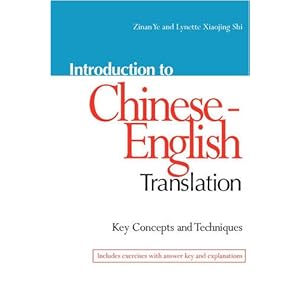
In September, MIIS Professor Anthony Pym interviewed MIIS Professor Zinan Ye, who teaches Chinese translation and Chinese site translation.  The interview discusses Zinan Ye’s popular column in the Chinese Translation Journal in China, as well as his books: The Theory and Practice of English-Chinese Translation (published in Taiwan and Beijing),  A Dialogue on English-Chinese Translation (published by Beijing University), and Introduction to Chinese-English Translation (published in New York and to be published in Taiwan — coauthored with Lynette Xiaojing Shi).

Photo: amazon

The interview also discusses how Professor Ye got from being a freelance translator in China without formal training to where he is today at MIIS.  In the latter part of the interview, Ye discusses the current situation of translator training in China, as well as the recent increase of Masters in Translation and Interpretation Programs in China, and he also gives his views on translation studies and translation research in China and his opinion on the Eurocentricity of the translation field.

Found in Translation Lecture: Interpreting for the US Dept of State by David B. Sawyer

The 7th Found in Translation lecture series

When: Monday, November 8, 6:00 – 7:30 in McGowan 102

Speaker: Dr. David B. Sawyer, Chief of the European Languages Branch and Senior Diplomatic Interpreter for German in the Office of Language Services at the United States Department of State. Previously, Sawyer was a freelance conference interpreter and Associate Professor of interpretation and translation at the Monterey Institute of International Studies, where he was head of the German program. He was on the faculty at the University of Mainz in Germersheim, Germany, where he earned graduate degrees in conference interpretation, translation, and a doctorate. He is a member of the International Association of Conference Interpreters and the author of Fundamental Aspects of Interpreter Education: Curriculum and Assessment.

Title of Lecture: Interpreting for the United States Department of State: History and Current Practice

The mission of the Office of Language Services (LS) of the United States Department of State is to facilitate communication with non-English speaking governments and people by providing high-level interpreting and translating support to the Executive Office of the President, the Department of State, and other agencies of the United States Federal Government. The Office of Language Services carries on a tradition of language support for the conduct of foreign policy that dates back to 1789, when it was founded by Thomas Jefferson, the first Secretary of State of the United States of America. This presentation outlines the history of LS, looking in particular at the development of diplomatic interpreting and its current practice. The views and opinions expressed are strictly those of the speaker and do not necessarily represent those of the U.S. Government or the U.S. Department of State.