Category Archives: United Kingdom

British Spy Agency Captured Journalists’ Messages Amongst 70,000 E-mails

The Government Communications Headquarters (GCHQ), the British sister agency of the National Security Agency, captured e-mails of some journalists out of 70,000 message intercepted in 10 minutes during a November 2008 test.

According to The Guardian, which on Monday cited some of its Snowden documents as its source (but did not publish them), the e-mails were scooped up as part of the intelligence agency’s direct fiber taps.

Journalists from the BBC, Reuters, The Guardian, The New York Times, Le Monde, The Sun, NBC, and The Washington Post were apparently targeted.

Read 2 remaining paragraphs | Comments

UK Prime Minister Wants Backdoors into Messaging Apps or He’ll Ban Them

David Cameron, the British Prime minister, is one-upping his Western allies when it comes to anti-encryption propaganda. Ahead of national elections in May, Cameron said that if re-elected, he would seek to ban encrypted online messaging apps unless the UK government is given backdoors.

“Are we going to allow a means of communications which it simply isn’t possible to read?” Cameron said Monday while campaigning, in reference to apps such as WhatsApp, Snapchat, and other encrypted services. “My answer to that question is: ‘No, we must not.'”

He said the Paris attacks, including the one last week on satirical newspaper Charlie Hebdo, underscored the need for greater access.

Read 11 remaining paragraphs | Comments

Researchers Uncover Government Spy Tool Used to Hack Telecoms and Belgian Cryptographer

Researchers Uncover Government Spy Tool Used to Hack Telecoms and Belgian Cryptographer

Piecing together new information from various researchers, it’s clear the ‘Regin” malware is one of the most sophisticated nation-state spy tools ever found.

The post Researchers Uncover Government Spy Tool Used to Hack Telecoms and Belgian Cryptographer appeared first on WIRED.


Highly Advanced Backdoor Trojan Cased High-profile Targets for Years

Researchers have unearthed highly advanced malware they believe was developed by a wealthy nation-state to spy on a wide range of international targets in diverse industries, including hospitality, energy, airline, and research.

Backdoor Regin, as researchers at security firm Symantec are referring to the trojan, bears some resemblance to previously discovered state-sponsored malware, including the espionage trojans known as Flame and Duqu, as well as Stuxnet, the computer worm and trojan that was programmed to disrupt Iran’s nuclear program. Regin likely required months or years to be completed and contains dozens of individual modules that allowed its operators to tailor the malware to individual targets.

To remain stealthy, the malware is organized into five stages, each of which is encrypted except for the first one. Executing the first stage triggers a domino chain in which the second stage is decrypted and executed, and that in turn decrypts the third stage, and so on. Analyzing and understanding the malware requires researchers to acquire all five stages. Regin contains dozens of payloads, including code for capturing screenshots, seizing control of an infected computer’s mouse, stealing passwords, monitoring network traffic, and recovering deleted files. Other modules appear to be tailored to specific targets. One such payload included code for monitoring the traffic of a Microsoft IIS server. Another sniffed the traffic of mobile telephone base station controllers.

Read 4 remaining paragraphs | Comments

Six Journalists Sue Over Surveillance by UK “Extremist” Police Unit

Six members of the United Kingdom’s National Union of Journalists—including comedian and journalist Mark Thomas—have filed suit against London’s Metropolitan Police after discovering that their daily activities were being monitored and recorded in a police database. The database is gathered by the National Domestic Extremists and Disorder Intelligence Unit, a task force led by the Metropolitan Police Service that tracks political and religious groups in the UK and monitors protests.

In an interview on BBC Radio 4, Thomas said that the surveillance was discovered through information uncovered by a request under the UK’s Data Protection Act—a law similar to the US’ Freedom of Information Act. “The police are gathering information under the domestic extremist list about journalist and NUJ members, “ he said. “And we know this because six of us have applied to the police using the Data Protection Act to get some of the information the police are holding on us on these lists. And what they are doing is monitoring journalists’ activities and putting them under surveillance and creating databases about them.”

Thomas has used the Data Protection Act in the name of both journalism and comedy. In 2001, he launched a contest in which he encouraged people to do creative performances in front of surveillance cameras and then submit the videos to him after obtaining them through Data Protection Act requests.

Read 2 remaining paragraphs | Comments

UK Spy Chief, Parroting His US Counterparts, Calls for Crypto Backdoors

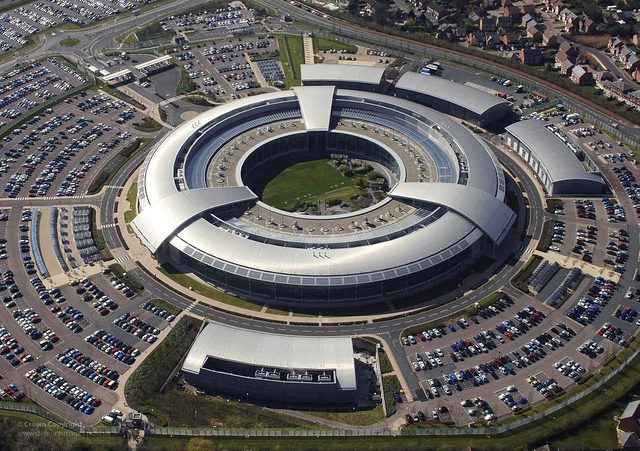
GCHQ building at Cheltenham, Gloucestershire.

Writing that “privacy has never been an absolute right,” Robert Hannigan, the head of British spy agency GCHG, urged the US tech sector to assist the fight against terrorism and other crimes by opening up their proprietary networks to government authorities.

Hannigan

Hannigan, in a Financial Times editorial on Monday, suggested that “technology companies are in denial” over the Internet’s use “to facilitate murder or child abuse.” He wrote that the time was ripe for “addressing some uncomfortable truths” and went on to say the public wouldn’t mind if technology companies gave governments backdoor access either.

They do not want the media platforms they use with their friends and families to facilitate murder or child abuse. They know the Internet grew out of the values of western democracy, not vice versa. I think those customers would be comfortable with a better, more sustainable relationship between the agencies and the technology companies.

“Better do it now than in the aftermath of greater violence,” Hannigan added.

Hannigan’s opinion piece follows similar comments by FBI Director James Comey and US Attorney General Eric Holder. And a day after Hannigan’s comments, the Electronic Frontier Foundation of San Francisco released a “Secure Messaging Scorecard” that rated which messaging technologies are “truly safe and secure.”

Read 7 remaining paragraphs | Comments

Bahraini Activists Hacked by Their Government Go After UK Spyware Maker

Bahraini Activists Hacked by Their Government Go After UK Spyware Maker

Human rights groups and technologists have long criticized Gamma International and the Italian firm Hacking Team for selling surveillance technology to repressive regimes, who use the tools to target political dissidents and human rights activists. Both companies say they sell their surveillance software only to law enforcement and intelligence agencies but that they won’t sell their software to every government. Gamma has, in fact, denied selling its tool to Bahrain, which has a long history of imprisoning and torturing political dissidents and human rights activists.

The post Bahraini Activists Hacked by Their Government Go After UK Spyware Maker appeared first on WIRED.