Tags » Weather


Snow Days

Categories: Weather

Luther Tenny (Facilities Snow Guru, and master of the Snow Plan) keeps much better track of snow storms than I. The weather station down at the track records liquid precipitation year round, thanks to a small heater melting snow in the rain guage. This has recorded .91″ so far in January, compared to 1.35″ to date last year. In December, 1.92″ of precip. fell, as compared to 1.5″ in 2009. The difference this winter seems to be frequency.

Luther reports 11 snow events so far this year, a snow event being one all of facilities needs to respond to. An average winter contains 18 snow events in total. He also states 19 of the last 20 days in January has seen some snow, and 24 of the 31 days in December.

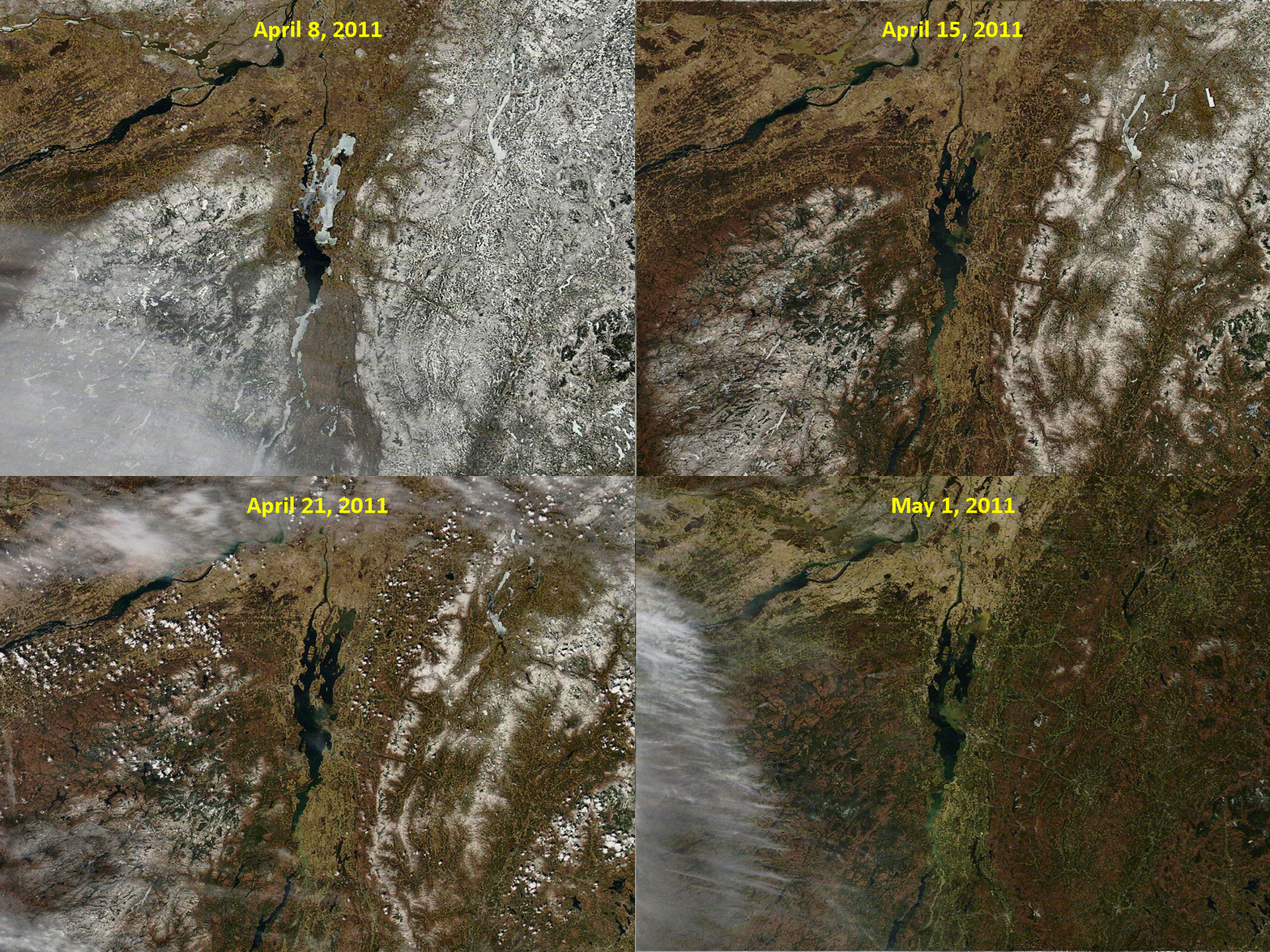
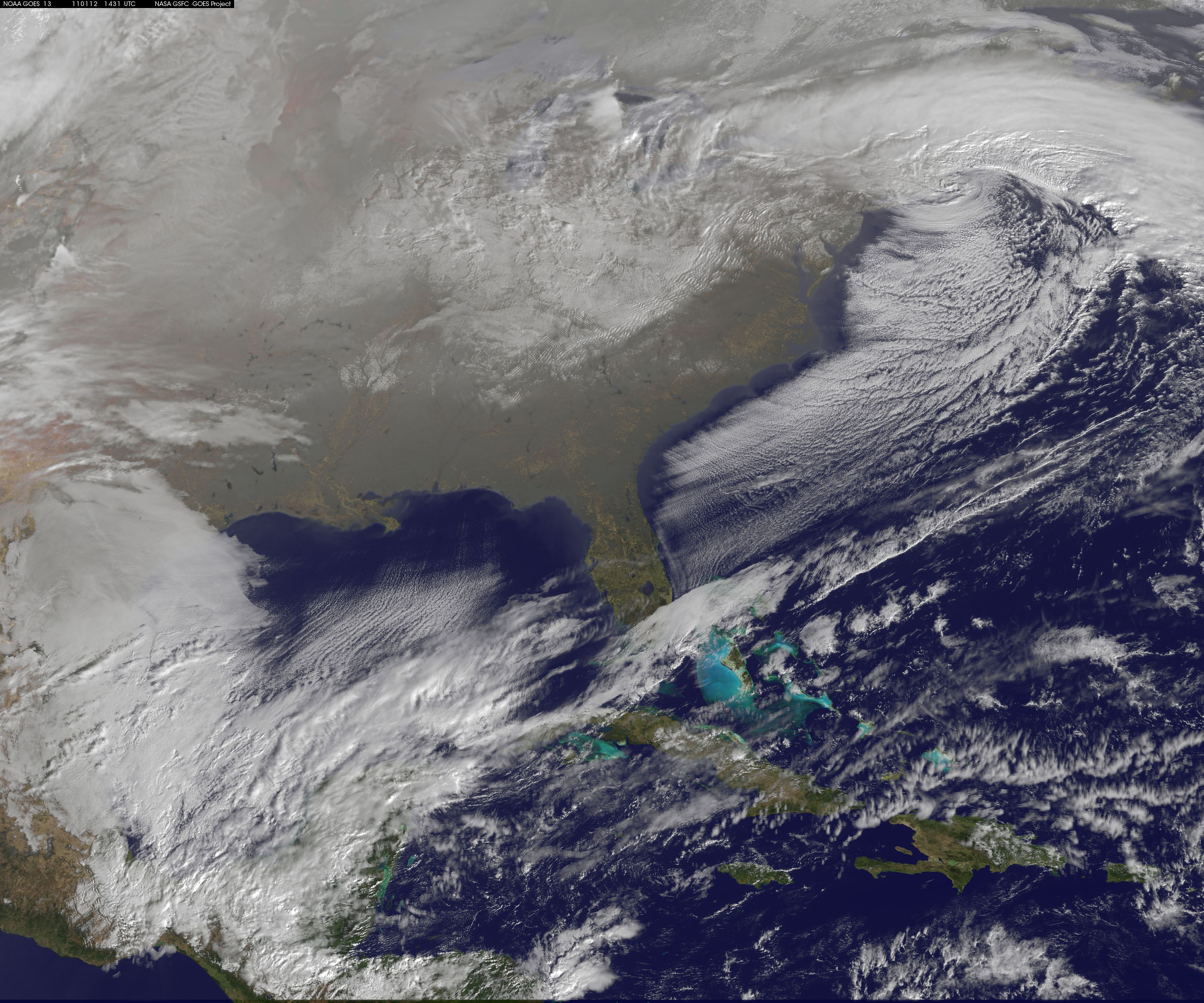
I never got around to posting this, but here’s a great satellite picture of the nor’easter that hit us on January 12. I’ve lost the name of the site it came from, but I remember it’s from the National Weather Service. We’re in a break from snow now, as the bottom seems to be dropping out of the thermometer. Some of the coldest arctic air we’ve seen in 2-3 years is plunging south, so stay warm.

Magic (Salt)

Categories: Weather

We’ve had quite the snow week, even though it rapidly disappeared in the rain Sunday. I’ve written about how we remove snow in the past, it’s one of my favorite posts. And what I said certainly still holds true, that a job well done means that no one really noticed we did anything at all. Presto, the roads and sidewalks are clear. This year, we’ve made it a little easier for ourselves, and for the environment, with clearer and safer surfaces to boot.

The issue with snow and ice is always one of traction. Getting rid of most of the snow is relatively easy. Shovels, plows, snow blowers, brooms, even backpack blowers are all used, depending on conditions. The challenge in the winter is the last 1/4″ or so, the snow or ice remaining that doesn’t want to go anywhere. The problem is warmth, and the fact that the very first snow that falls on sidewalks or roads bonds to the surface, and can be very hard to scrape away and remove. This is what makes winter treacherous, and what makes walking and driving difficult.

In the past, Facilities Services has used sand, and a lot of it. Spread on top of this bonded snow/ice hard pack, the sand gives traction on top, making the walk or road a little less slippery. Most of the time. Sand comes with costs, though, some obvious, some not so much. Sand use in winter is linked to phosphorous loading in streams, sedimentation buildup in catch basins, retention ponds, and waterways, and even airborne pollution, as the cars and trucks driving across the sanded surface grind the particulates into finer particles and allow them to become airborne. But the worst part of sand? The carbon footprint, not only in spreading a heavy product, but repeated trips to refill, the continual scraping of the surface to try and remove the leftover hardpack repeated over days, and worst of all, the massive amount of work and fuel required in the spring to clean all the sand up. After all that work, there is still snow and ice left on the walk. The sand seems to disappear, moving off the hardpack to the edge, and the walks are slippery again.

The other solution to the ice problem is to get rid of it, frequently by melting it. In a bulk scale, this usually involves rock salt. Ever make homemade ice cream? Rock salt lower the freezing point of ice, so that it stays liquid at a colder temperature, allowing the milk to freeze. Applied to a road, the salt thaws the ice or snow hardpack, where it runs off as water, drying the road. This certainly has it’s problems too, not only in the carbon footprint to get salt across the country, but in effects both in water and soil of excessive salts. There are other ice melter products, from calcium chlorides to magnesium blends used on airport runways, but most bulk applications still rely on plain old salt.

Facilities wasn’t satisfied with sand, as anybody walking across our sidewalks in the past might attest to, but we weren’t sure about salt, not wanting to make an environmentally worse choice. (It’s neck and neck, actually, between sand and salt, if you actually take the time to weigh the pros and cons.) A couple of years ago we started using Ice Ban as a pretreatment. This liquid is the byproduct from food manufacturing (I believe our source is actually from beer), and sprayed on sidewalks and roads before a storm can prevent the dreaded bond from forming, allowing the snow to be completely removed. This is tricky, though, as conditions need to be perfect in order to apply, and this only seems to be about 2/3-3/4 of our snow events. Then we discovered magic.

Magic Salt is ordinary rock salt treated with ice ban, or an equiviant. This agricultural by-prodcut gets sprayed on the salt, turning it brown and giving it a somewhat funky smell. It makes the freezing point of water drop even lower, meaning less treated salt is needed to melt the equivalent amount of snow or ice. Some estimates claim 30-50% less. And much much less sand/salt mix, up to 3 times less. Less product=less carbon. And we’ve got cleaner sidewalks. This is our first year of trying Magic Salt, and so far we’re impressed. But don’t take my word for it, the proof is in the pictures.
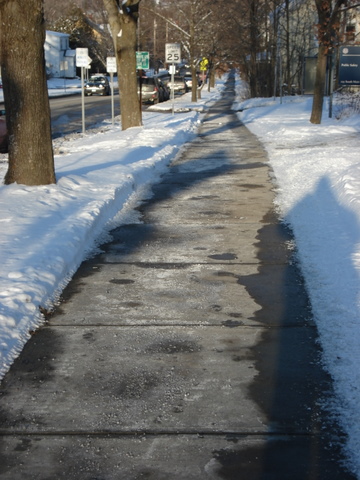
Here’s a sidewalk treated conventionally with ordinary rock salt (not by the college). Yes, the sidewalk is clear, but note not only the chunks of excessive salt remaining, but the white residue of the salt on the walk. It’s very easy to over apply salt.
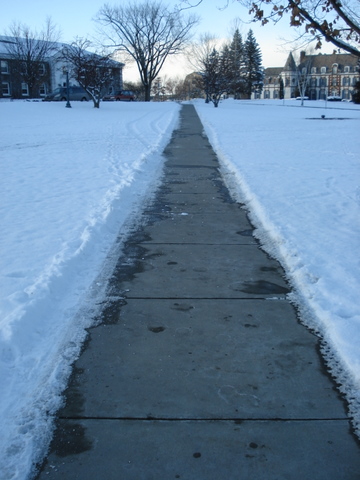
This is one of our walks, treated with Magic Salt. Very clear, but notice there is no excess salt on the surface, and no white buildup of salts on the sidewalk either.
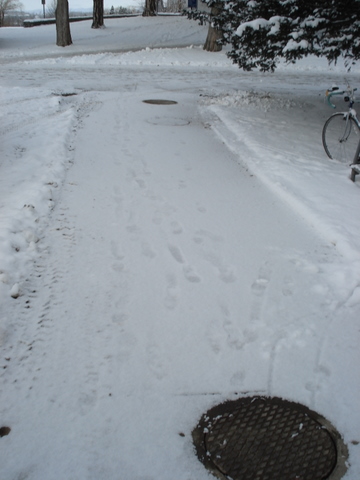
One night this week it snowed on top of cleared sidewalks in the middle of the night, and night time temperatures were in the single digits. Temperatures this cold are below the effectiveness of straight salt, it just won’t melt the snow. The sidewalk above was treated with straight rock salt the day before, and you can see the bond that formed between the walk and the snow. There are footprints in the snow above. Compare it to the the picture below.
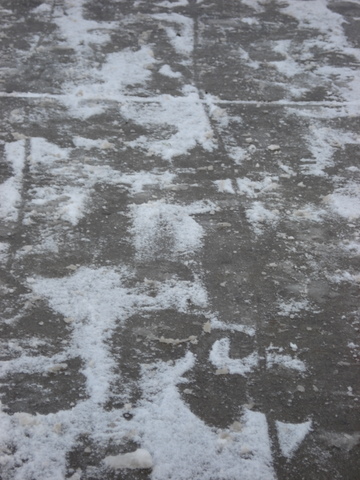
This sidewalk was treated with Magic Salt the day before, and, while it has received more foot traffic than the walk above, you can still see how there is no bond formed. Even walking on this sidewalk was more pleasent, and not as slippery as if the snow had bonded down. And with this type of surface we can…
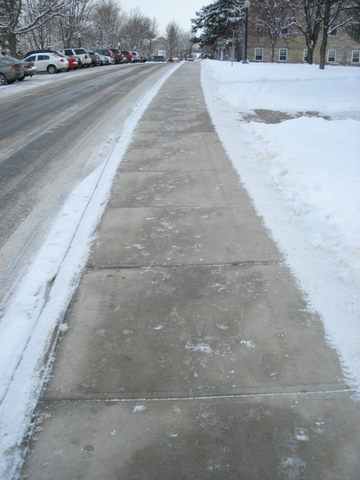
Sweep the walk clear. A broom on one of our tractors came along and in no time at all discovered the bare surface again.
New Breadloaf Weather Station

Categories: Weather

Thanks to Environmental Council, Facilities Services has installed a second weather station, this one up at Breadloaf campus. It’s hanging on the side of the Laundry shack, next to the really cool old telephone booth. We use weather information from the station on main campus all the time, from worrying about snow removal to tracking growing degree days. Now, not only will we be able to do that for Breadloaf as well, but now us Nordic skiing addicts will be able to plan our waxing for the day on the drive up.

For now, the best place to see the weather information is on the Weather Underground, where we are live streaming the information. They generate a page for the Breadloaf station, as well as Main Campus.

What a Storm

Categories: Weather

“No enemy but the weather, and the wind, the wind, the wind.” Michael Carey, from “The Thing about Farming”, The Noise the Earth Makes.

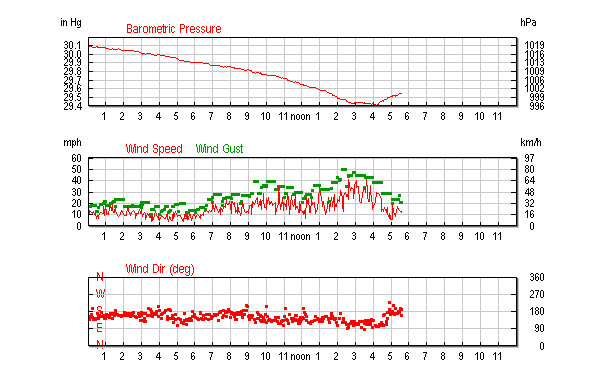
We had some wind yesterday. I’m thinking you noticed. Peak wind gust at our Middlebury College Weather Station was recorded at 51 mph, but what I found most impressive was the sustained wind speeds, wind speed averaged over the course of a minute. The highest recorded was 47 mph, but between about 2:30 and 4 the wind averaged between 30-45 mph. That’s impressive.

As you may know, wind is formed by air being pushed between two fronts. Yesterday a strong low pressure system pushed off high pressure off the coast, and the great difference in pressure and speed of the approaching front caused our extreme winds. Looking at the weather graphs for yesterday, you can see the barometric pressure was dropping as the cold front approached, and see the wind speed increasing. The front passes us at 4, and the wind speed dies down.

Lightning Strike

Categories: Trees, Weather

Our wild and crazy summer weather here at Middlebury continues, this time with a tree being struck by lightning. (Side note to the faithful readers out there. I feel for you-has this blog been getting depressing lately? With vandalism, more vandalismstorms, more storms, even still more storms, and disease,  it seems like the Middlebury Landscape is getting tragic. Hold the faith! We’ve been planting as well. Posts coming soon on this year’s tree plantings, as well as a new look for Pearson Hall.)

Ginkgo at 121 South Main

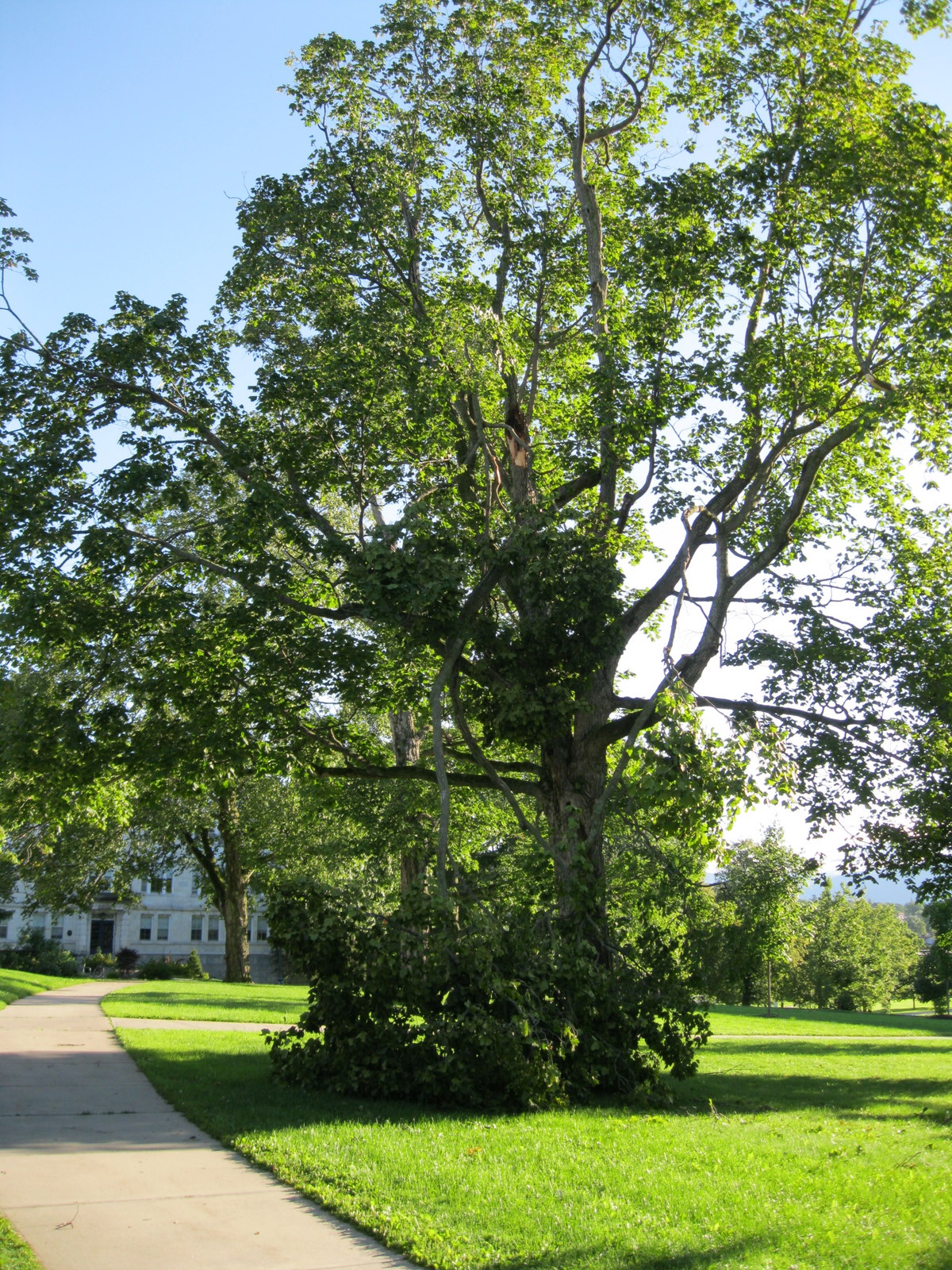
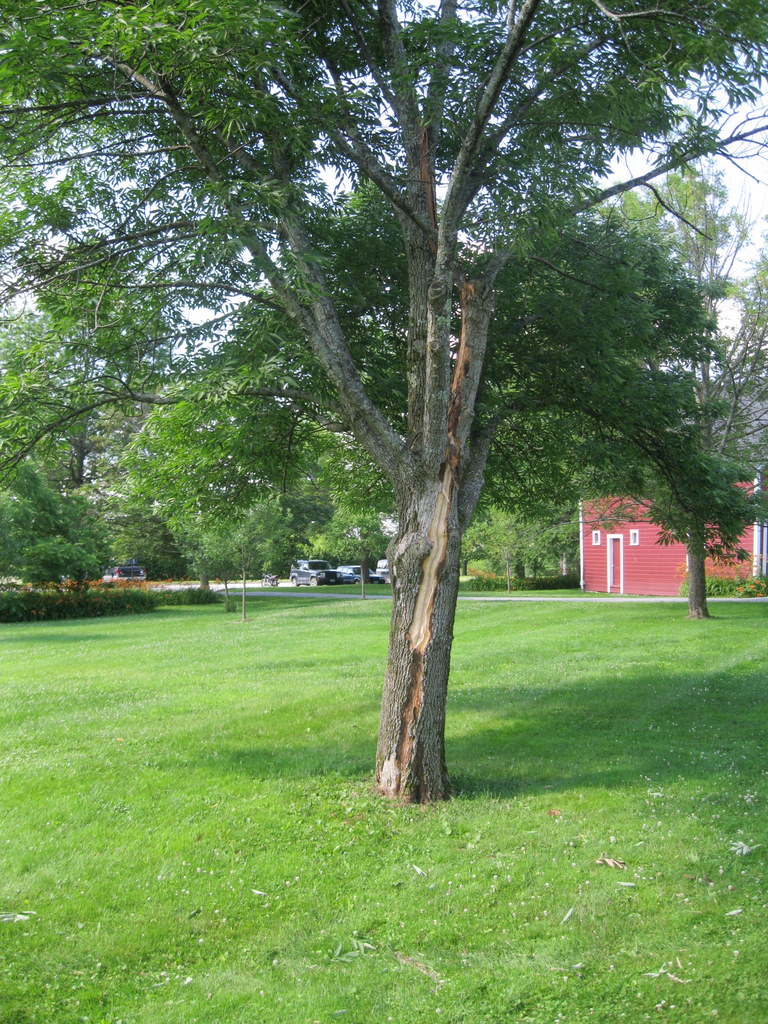
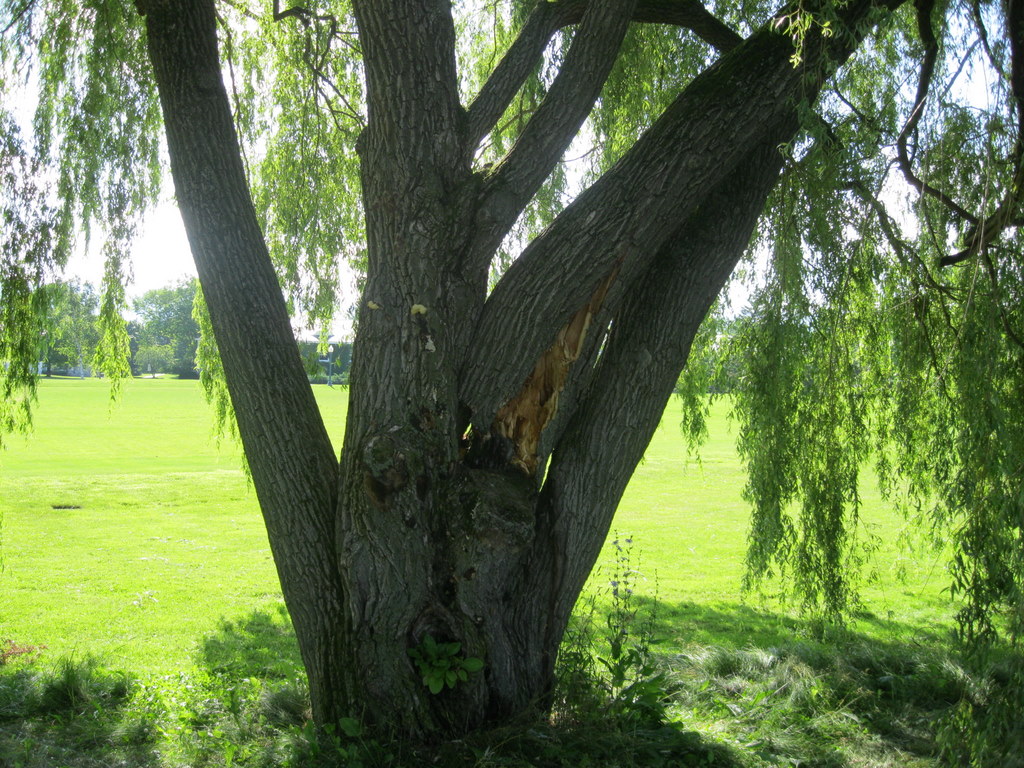
The tree hit is a Ginkgo ( read here if you’ve forgotten about them) located in front of one of Middlebury’s “outside” houses, near Public Safety at 121 South Main Street. I don’t know the night it got hit, but it was brought to my attention by one of the diligent members of our crew. Looking at the tree originally, I first thought the tree had just cracked down near the base, possibly in some strong wind. The tree shows what arborists call co-dominant trunks, where two trunks of equal size meet and grow together. This is frequently a recipe for disaster, as a bad union often results, where included bark makes a weak joint, and the two trunks typically fall apart away from each other.

Co-Dominant Trunks-click for a larger view to see the wound

I called an Arborist friend to consult on the damage-this is one of our favorite trees in Facilities, many of us would mourn the loss. His skill, knowledge, and experience led him to look up the tree, rather than me just jumping to the first obvious conclusion, and that was how he discovered the damage around the cable up top, as well as noticing the toothpick sized wood pieces scattered around the yard, small pieces of trunk blown away from the tree from the force of the lightning. Being tree geeks, we climbed up to investigate.

Damage around one the cables

Damage on another limb-the lightning jumped to this branch

Trees are frequent targets of lightning. Standing alone, frequently taller than many buildings around them, many trees get hit each year. Lightning is fascinating all on it’s own, with their impressive 100 million volts and  temperatures greater than 50,000 degrees fahrenheit. 16 million lightning storms are estimated worldwide in a year, and measuring instruments record over 100 million strikes in the U.S. each year, killing on average 90 people. They even get their own phobia, Astraphobia, fear of lightning.

The conditions needed for lightning are still debatable, but should those conditions exist, negative ions accumulate at the base of the storm clouds, while positive ions pile up on the ground. “Stepped Ladders” descend from the clouds, while “streamers” arise from the earth, typically strongest from the tallest structures, such as buildings or trees. Should they build strong and fast enough, they meet to form a lightning bolt, and this electrical discharge super heats the air around it to 36,000 degrees fahrenheit, compressing the air creating supersonic shock wave we hear as thunder.

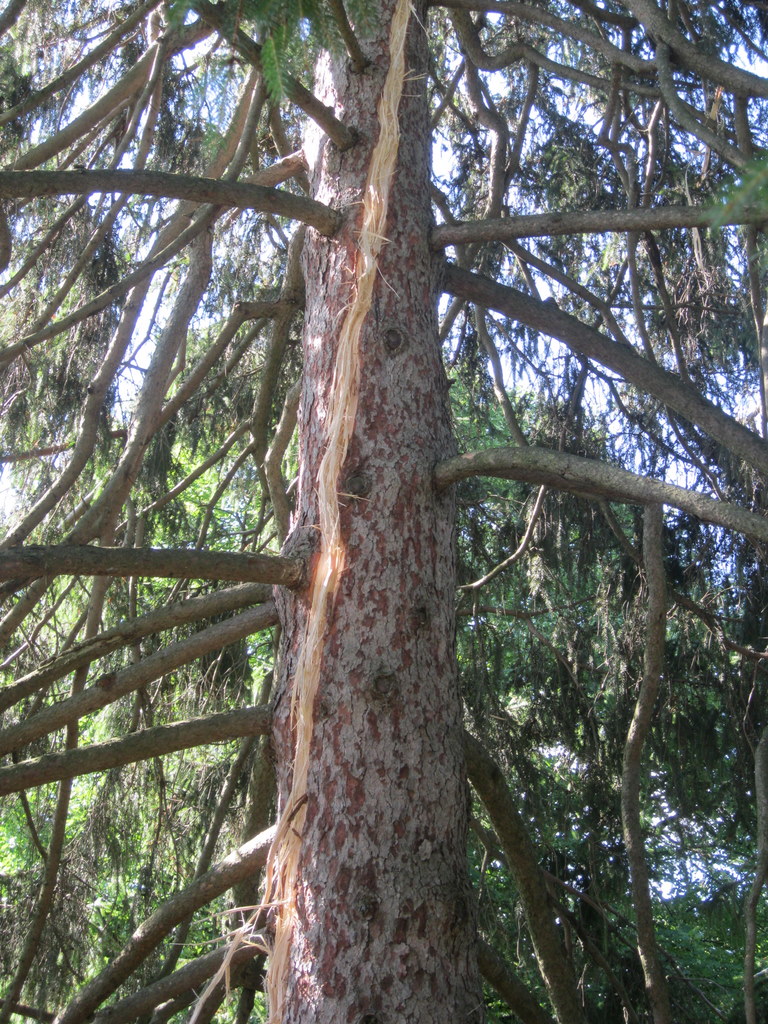
When lightning strikes a tree, the sap in the tree boils, turning to steam and blasting the bark away from the trunk. The electrical charge flows through the tree, exiting out the root system, which could be severely damaged in the process, sometimes with no visible sign above. In most cases, though, a strip of bark is torn from the tree, often in a long strip, but sometimes, like this ginkgo, only above and below. Trees with only one crack tend to close the wound and suffer, yet live, while trees with wounds on both sides of the trunk are frequently killed outright. Obviously, even a wounded tree can die from secondary reasons, such as insects and diseases, less able to fight them off.

Trees vary in their susceptibility to lightning strikes, possibly for biological reasons, or possibly simply because of their height. Elms, Oaks, Black Locust and Ash tend to be very susceptible, while Beech, Horsechestnut, and Birch tend to not be very susceptible. It may be the starch content of the tree making it more susceptible, while resinous trees are poorer conductors.

So there is hope for our Ginkgo. The wound at the bottom was traced, where loose bark is peeled away carefully from the trunk to the point where it attaches again. The thinking with bark tracing is that loose bark can trap moisture and disease, so by removing it the wound can dry better. Maybe it’s just something to do to make arborists feel not quite so helpless…

Lower wound after tracing

Lower part of wound where lightning went to ground

The cabling up in the crown of the tree is a little more problematic. Originally put in place to help stabilize the two co-dominant stems, the system now obviously cannot be trusted, as the wood surrounding the bolts holding the cable is now dead. We decided to replace the cable with two others, one above the old cable (a better location from an engineering perspective), but also one looser below, in case one of the stems fails completely at the original cable site, and breaks. The tree will then still be braced by the lower cable.

Placing the cables in the tree

The three cables in place

So now, we wait. The rest of this year, and into next spring, will be the crucial time, and when we shall see just how bad the strike was. Should it still appear somewhat healthy next spring, we will aerate the soil around the tree, add compost, fertilize, and mulch. Hard to imagine now, but, if we get a little drought this summer, we’ll even go down to water.

Another Day, another storm

Categories: Trees, Weather

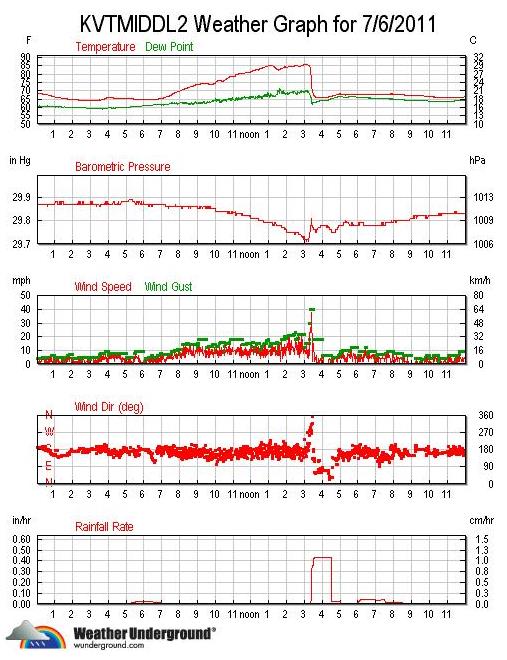
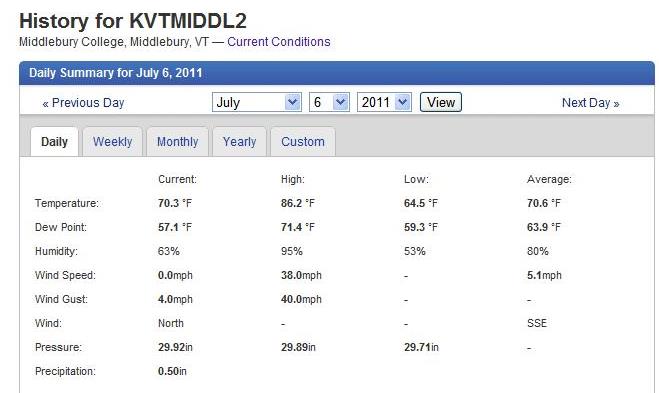
The storms certainly keep coming, and, worryingly, the trees keep succumbing.  Today at 3:30 a very brief but intense cell blasted through campus. We’d lost power for a little bit, I don’t know why. The weather station recorded about 1/4″ of rain in 15 minutes, with a peak wind gust of 35 mph, from the north. This was enough to take the life of a poor Hackberry tree.

Hackberry by Warner Science

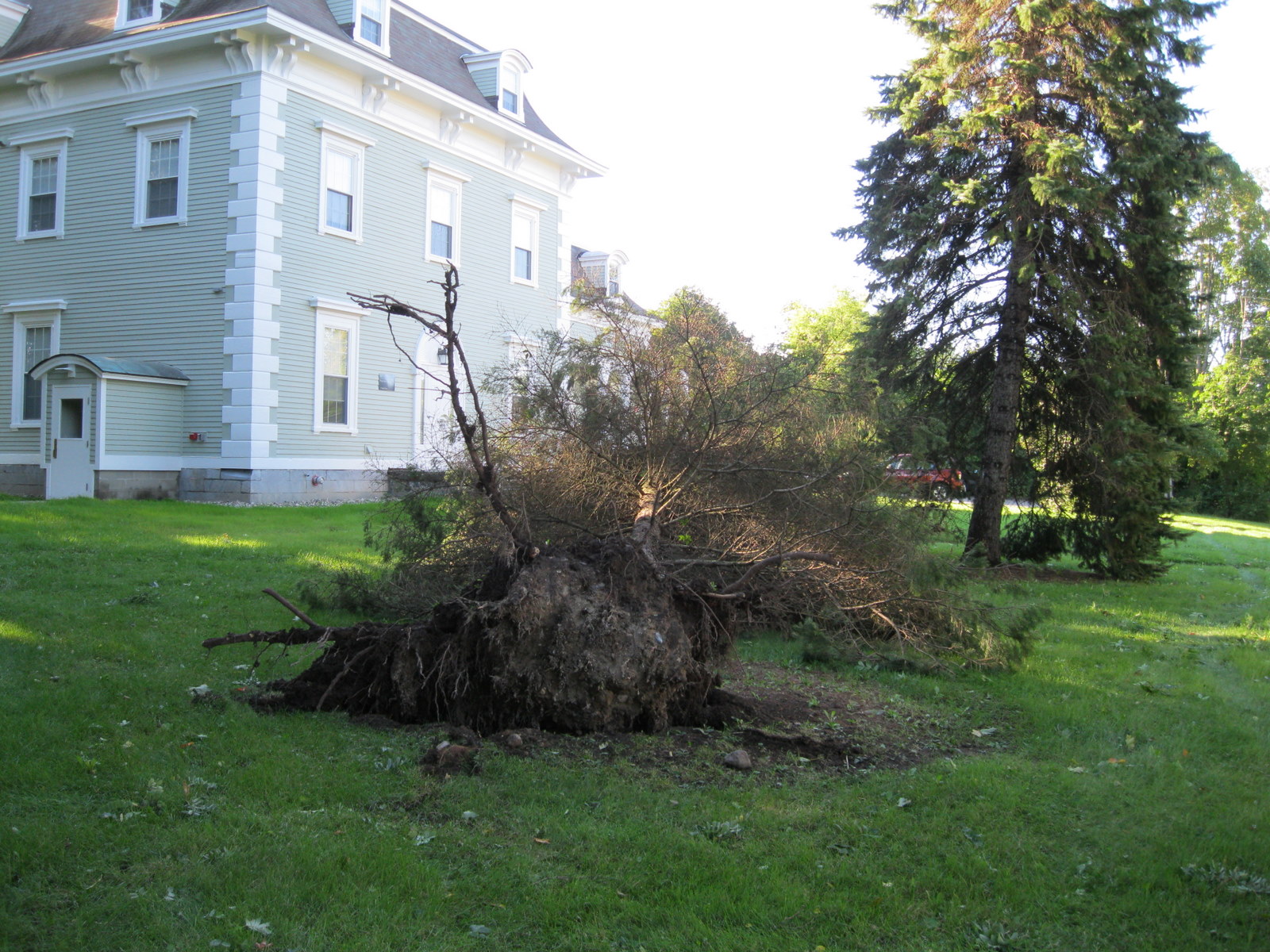
This poor tree had been scarred at the base years ago, maybe by a random mouse, maybe by something mechanical. At any rate, the worst place to wound a tree is right at the base. A tree has a very hard time compartmentalizing the wound at the base, and structural integrity of both trunk and root system is compromised. Look at the picture below-the wound was on the north side of the tree. The roots rotted away on that side, and the strong north wind gust toppled the tree right over.

Base of Hackberry

I took these pictures on my way home at 4, but I would imagine the rest of the campus trees are fine. A perfect wind knocked this one down. I’ve already got a replacement in mind.

EDIT: Middblog just posted some YouTube video of the rain here-it’s impressive.

If a Tree Falls…

Categories: Trees, Weather

I’m not much of a Twitterer, although I’ve been called a twit many times.I don’t want to get tweets on my cell-my phone vibrates so violently at the slightest ring or text message that while weeding I end up shrieking like my 10 year old thinking I just weeded a bee’s nest. But I do check some from time to time, MiddBlog being one of my favorites, and they cross-tweeted (is that the right phrase?) a posting from Audrey Tolbert, who with Cody Gohl are blogging their Middlebury summer. (They are going to learn the Vermont secret-we put up with winter for the summer. Not too hot, not too sticky, and, so far this year, not too buggy.)

Anyway, she posted a picture asking“If a tree falls in Midd and there’s no one on campus to hear it, does it make a sound?”. Yes, Virginia, it certainly does.

Silver maple-Hillcrest Road

Silver Maple-Hillcrest Road

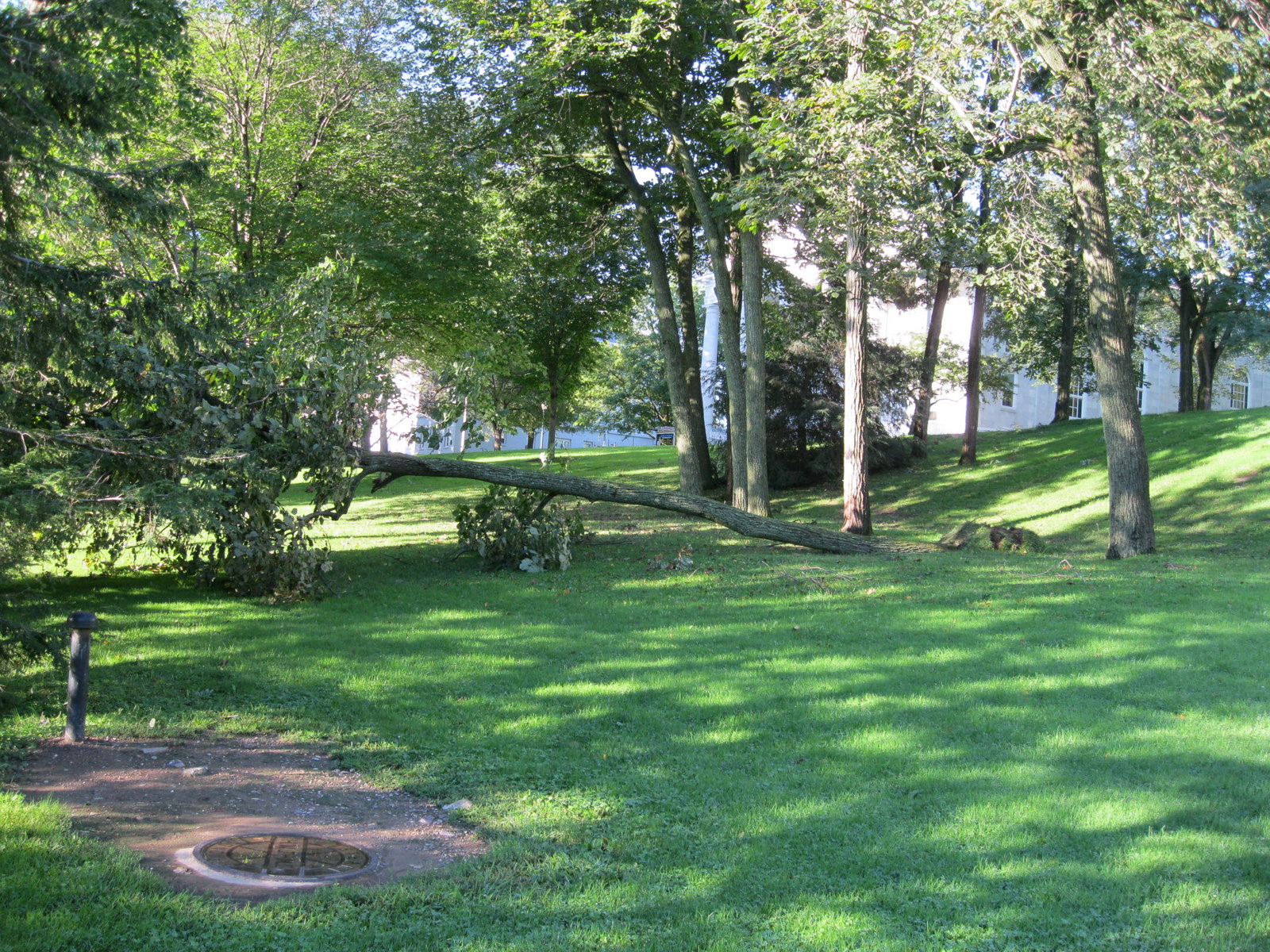
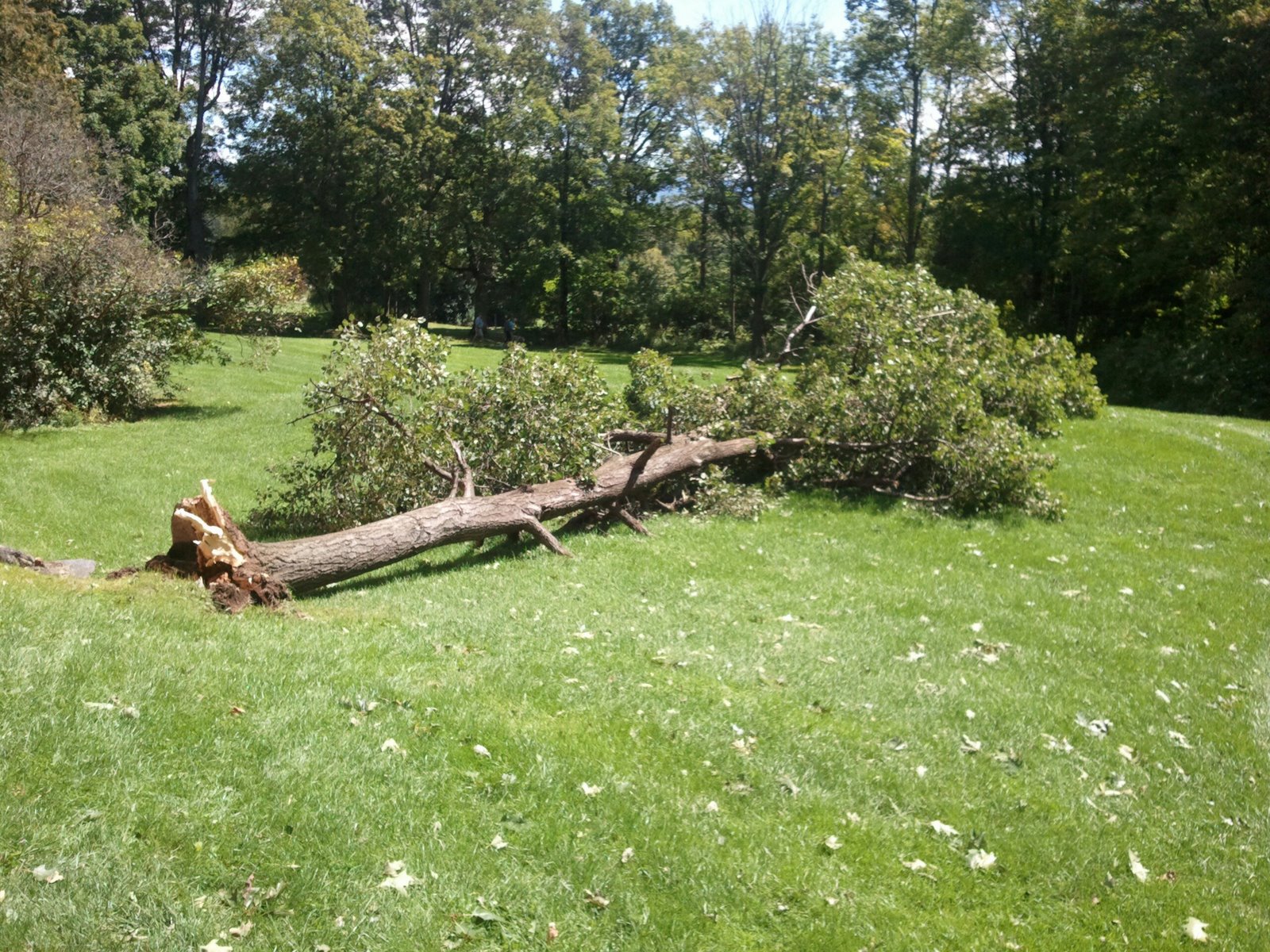
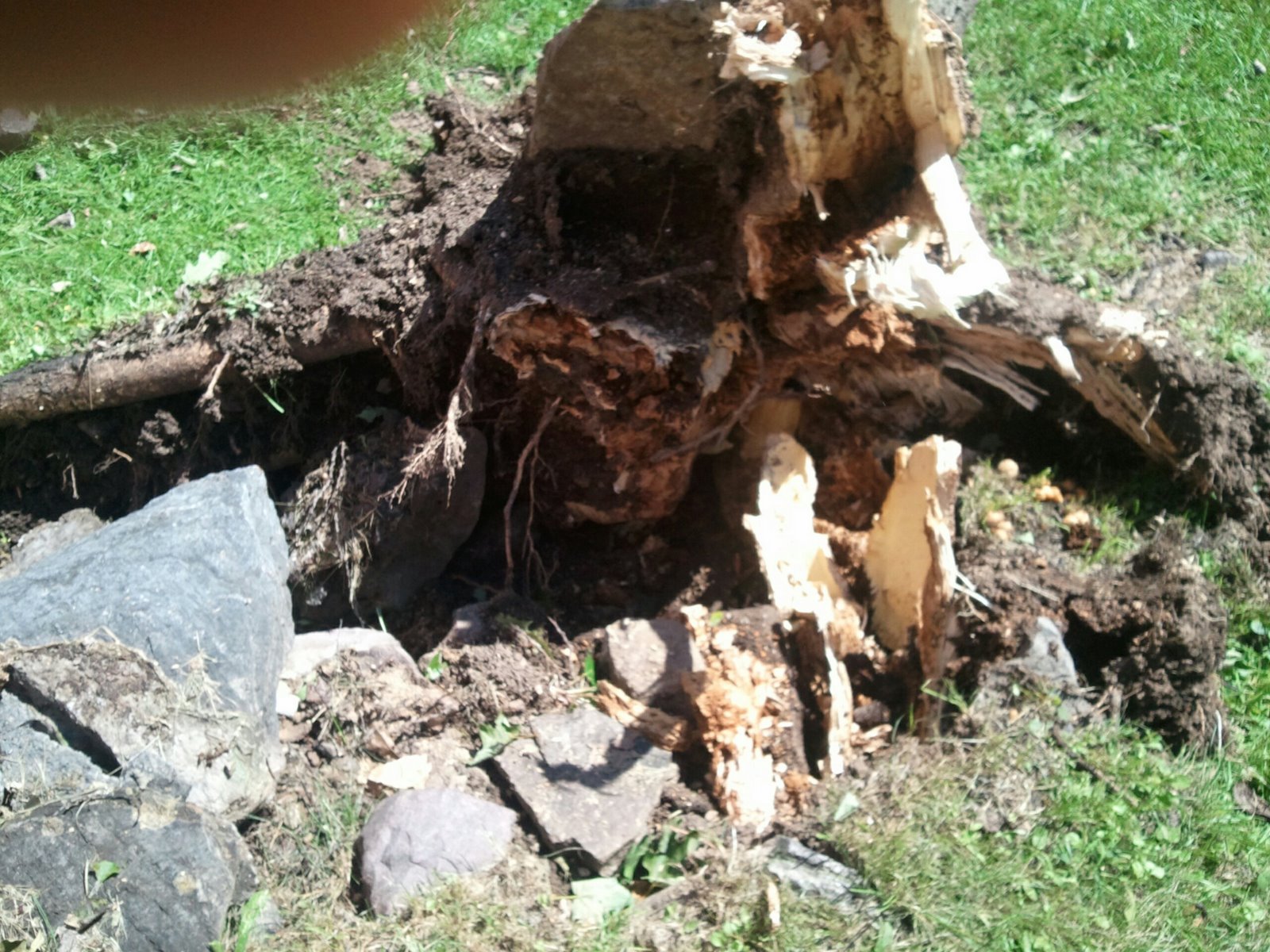
This is a Silver Maple tree behind the Chellis House. The storm I reported on last week, well, this was one of the trees that fell over. The picture does not do the size justice, as the trunk of the tree was at least 4′ in diameter. Look carefully, you’ll see about 1-2″ of live wood around the trunk, and the rest was hollow.

Close Up of trunk

One of the surprising things about this tree falling was its aim-it fell in absolutely the perfect direction, missing the woodline separating Hillcrest Road from Adirondack Road, missing Chellis House, the Queer Studies house, and the garage next to Chellis. We couldn’t have asked for anything more.

I wasn’t going to write about this poor tree. I am actually embarrassed by this. While I knew the tree had structural problems, I had no idea the extent of the damage inside the trunk. Look at the close up picture-those are weeds growing between the main stems at the top of the trunk. Large trees like this will often collect leaves there, and eventually grow things. It is the trunk decay that is surprising, and I feel like I should have known about this problem. Two arborists I respect both looked at this tree, though, and said that I had no way of knowing how bad it was, that they see this all the time, one going so far as to say “this is what Silver maples do.” So they made me feel a little better, and now I’m not blushing in embarrassment posting these pictures.

This tree is now cleaned up and gone. We’ve caught up on most of our storm damage, thanks to some very hard work by our landscape department and some excellent outside contractors. The elm I wrote about below Mead Chapel is OK, although more bare now. Once the hanging branches were pruned out there was more left of the tree than I had first thought, so that’s good. Many of the elms had some broken branches here and there, and a handful of other trees on campus had a branch or two break. Overall, not as bad as it could have been.

The wind, the wind

Categories: Weather

One of the most impressive thunderstorms I’ve seen ripped through campus Wednesday night, starting about 8:00. From my house in Weybridge it was a continual light show; not just flashes of lightening here and there, but the sky constantly lit as bolt after bolt attacked the ground and sky. Torrential downpours accompanied the storm, with driving rain, straight down. No massive wind gusts in Weybridge, though, at least my end, so I was unprepared for the damage I saw on my drive to work on Thursday.

The Burlington Free Press has a very good explanation of the development of this storm. Thunderstorms build, using the heat at the surface, which rises and is full of potential energy, explaining why most thunderstorms happen later in the day. Wednesday had record breaking heat, in the low 90′s, but a cap of warm air prevented the hot surface air from rising too much.  A rare cold front pushed down from the northeast, wiping out the cap of warm air that was sitting several thousand feet up, letting the storm build quickly, seemingly out of nowhere.

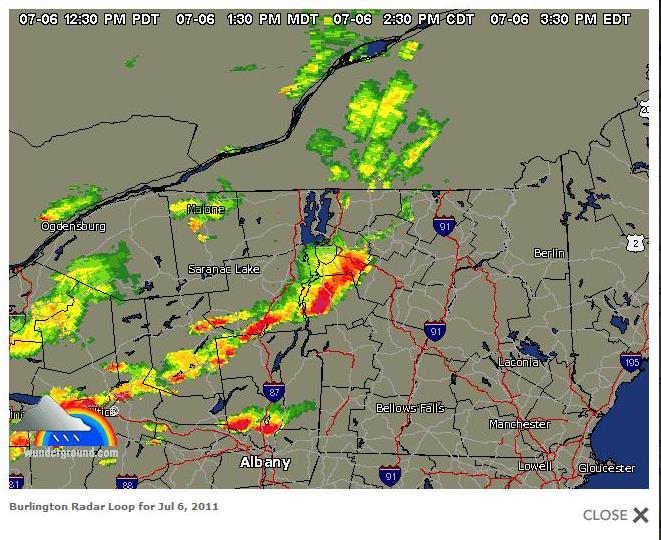
Weather obsessive that I am, the Weather Underground sends me emails for severe weather alerts, and when I got one late in the day I looked at the radar map, and saw nothing but clear skies, with a little storm near the Quebec border. Half an hour later or so, I see some impressive lightening to the north, so I run to the laptop, and glance at the radar again. (OK, very obsessive.) A huge storm was just north of us, and I was glad, and a little bummed, that it missed us. For kicks I set the radar to run a time lapse loop, to check the speed and direction of the storm. I didn’t know about the front pushing from the northeast, so was shocked to see this storm flying south from the north, as most storms have the common sense to go west to east. The radar was impressive enough I stuck a flashlight in my pocket, expecting to lose power.

Like I’d mentioned above, no wind in Weybridge. In town and on campus was a different story. As thunderstorms build, hot air at the surface rushes upward, creating an updraft. What goes up must come down, and downdrafts in thunderstorms are common. When severe enough, greater than 59 mph, they are called ‘straight line winds’, and can mimic tornadoes in the amount of damage. To differentiate them from tornadoes, one needs to look at the type of damage, and, sadly, an easy way to do this is with trees.

Middlebury’s weather station only recorded a peak gust of 41 mph, but that is down at the track. The Mead Chapel quad probably experienced straight line winds, based on the damage to some of the trees. Luther Tenny, fellow obsessive, noted how similar the tree damage was to an ice storm, with many branches hanging straight down, as if loaded with ice, broken from the weight.  It was an astute observation, and a good indication of a staight  line gust.

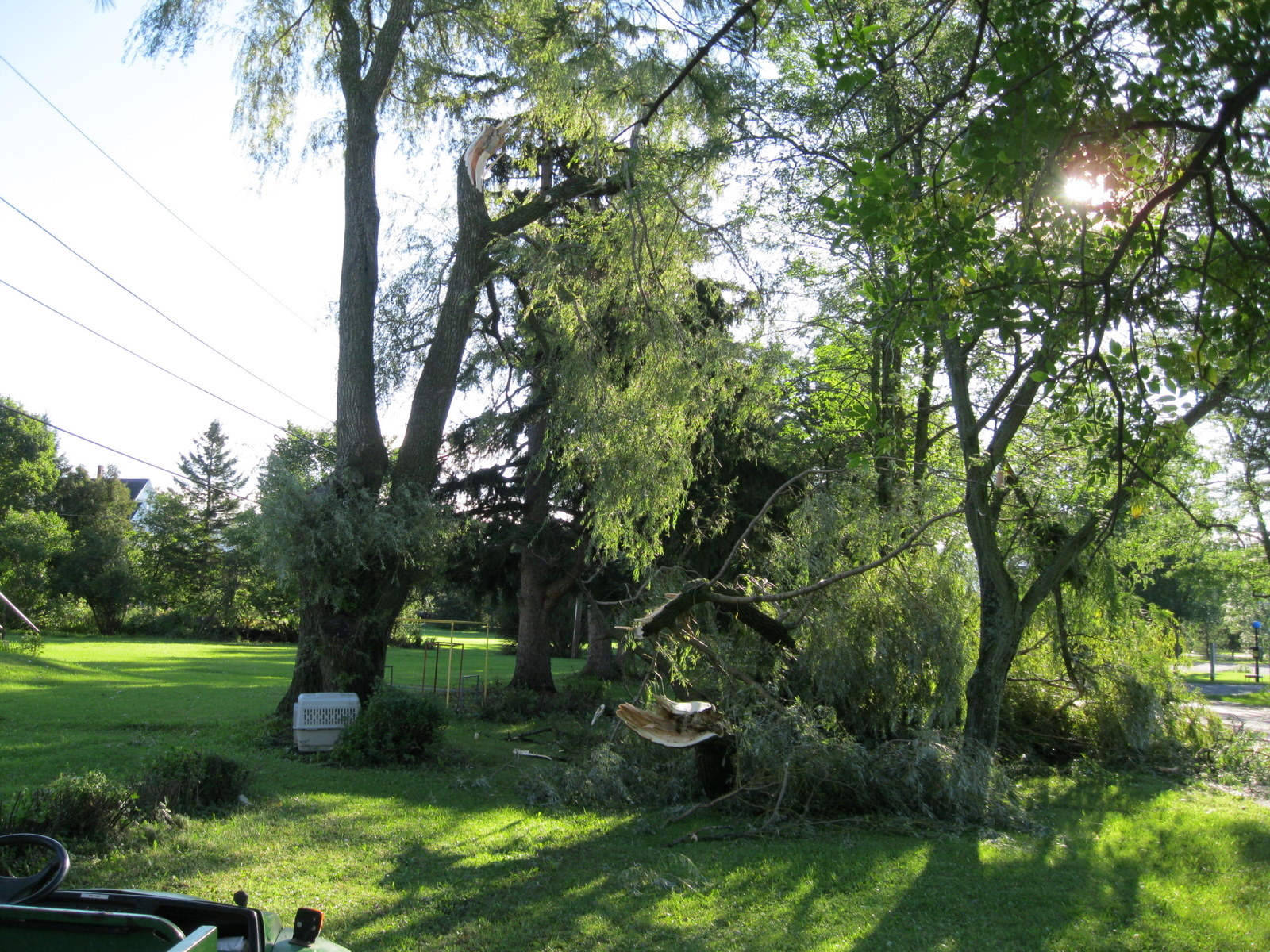
Some trees on campus lost some large branches, and many lost smaller ones. We spent most of the day picking them up, and we’ll be pruning trees for the next several. A large Norway spruce that was hollow fell across Porter Field Road, displacing a squirrel family that didn’t have the good sense to leave until we cut into the trunk to get rid of it, scaring the heck out of the chain saw operator. A huge Silver Maple, also hollow, fell behind 70 Hillcrest, missing everything in the yard. The tree had a 2-3″ band of living tissue holding it up-the remaining 4-5 feet (!) of trunk was hollow. Other large branches fell here and there, but no property damage or broken electric lines.

The tree that took the storm the worst, though, may be a large elm below Mead Chapel. This is the tree that looks like an ice storm hit it. Most of the crown seems to have snapped downward, like the downdraft was right above it. We’ll prune the broken branches out of the crown, and see how much of the tree remains. I’ll keep you posted.

It’s Snowing, and it’s almost May

Categories: Weather

April 27th, and there is a couple of inches of snow on the ground. Enough so I’m wondering if the Montery School needs any landscaping help. It’s not the snow that’s disconcerting, it’s the 3-7 ” additional forecast for tonight. The temperatures yesterday were in the 60′s, and now it’s about 36.

Here’s a slideshow of some pictures of the snow. Click on them for a larger, colder, and slightly more depressing view.

Wind Damage

Categories: Trees, Weather

I’m happy to say that Middlebury didn’t suffer much for tree damage from the storm I wrote about last week. Peak wind gust was only 34 MPH, but power was still out on campus for the better part of the morning. From what I understand a tree fell on a line near a substation. I’ll bet it was nice to have a half of a snow day-bet you thought you out-grew those once you graduated high school. It was nice to see the students making a productive use of their time. And yes, the guys in our landscape department feel bad when we have to plow some of them over. Like real estate, people, it’s all about location, location, location. Think before you sculpt, please.

We lost some branches here and there, notably in some White Pines near Hadley House and Perkins. Some large dead wood also fell out of Sugar Maples near Warner and Starr. Our vigorous pruning of trees on campus prevented a lot more damage, though, as most wood that falls out of trees is dead wood, and we remove much of that before it falls. Two trees did break some live wood, and I feel badly for them.

One is a rare (for this zone) Lacebark Elm in the front quad. You can see the broken tree as you drive south on Route 30.

Lacebark Elm

Lacebark Elm

This is a special little tree, and fortunately the break, while large, probably won’t permanently disfigure the tree. The damage was primarily one large scaffold branch breaking away from the main trunk, and was not surprising. This union between branch and trunk was a weak one, characterized by included bark growing between the two. As the bark on both stem and trunk expand through the years, it pushes against each other, causing the separation to widen. As you can see in the trunk close-up, the dark colored wood was always exposed to outside air-it is the light colored wood that was the sole attachment, and that is where it broke.

Closeup of damage

Closeup of damage

Proper pruning when this tree was young would have prevented this from occurring. Unions like this are easy to spot, and when removed young cause no permanent damage to the tree.

The other significant damage that occurred was more surprising, and also more sad. The wonderful Russian Olive tree just north of the new McCullough plaza lost a couple large branches on the right side, and will be much more noticeable when removed, disfiguring an admittedly funny tree-possibly the state’s largest.

Russian Olive

Russian Olive

This small tree is more often a large shrub-making this specimen quite old. The damage on the left side was from excessive end weight. As the snow collected on the tips of the branches the main stem could no longer hold it, and it broke. The species is not known for very strong wood; being a shrub at heart that is not very surprising.

Damage on the Russian Olive

Damage on the Russian Olive

We’ll prune away the damaged branches as best we can, and attempt some pruning on the other side to balance the rest of the tree out. I’ve been asked about replanting more of this species, but the plant is considered an invasive species, and is currently on the watch list by the Vermont Invasive Exotic Plant Committee.  It’s wonderfully fragrant creamy yellow blossoms in June and July are followed by fruit widely spread by birds, replacing native plants. While birds do love this plant, better bird species richness is found in native plant stands. There are plenty of other fragrant trees and shrubs to pick from in June and July, but I do like the silvery leaves of this one.